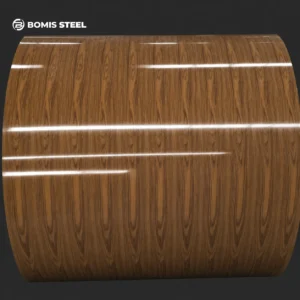
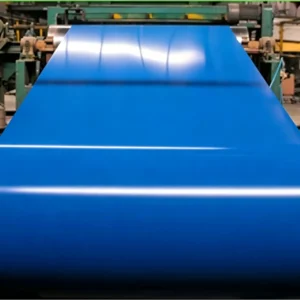
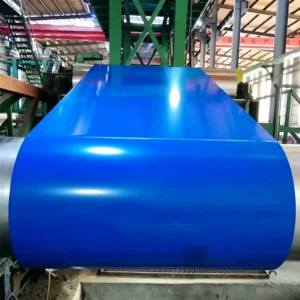
Wood grain PPGI steel strip is a prepainted galvanized steel coil that has been slit to narrow widths and printed with a realistic wood grain pattern. The base is a standard PPGI or PPGL substrate: hot-dip galvanized or galvalume steel with a primer coat, then run through a multi-stage roller printing process that applies the wood grain design, followed by a clear protective topcoat. The result is a steel strip that looks like oak, walnut, cherry, or teak but handles like coated steel: it resists rust, cuts and forms on standard tooling, and does not warp, crack, or rot the way real wood does.
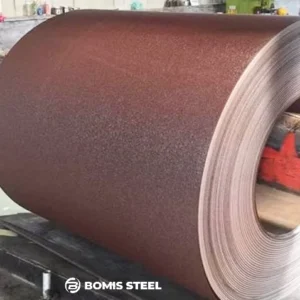
For buyers who prefer a textured decorative finish without a wood pattern, our wrinkle PPGI steel coils offer a distinctive three-dimensional wrinkle surface with comparable forming and corrosion-resistance properties. The narrow strip format (20 mm to 600 mm wide) makes this material a direct fit for roll-forming lines, continuous stamping operations, edge banding, and trim manufacturing. It arrives in coil form ready to feed into automated processing equipment.
| Specification | Details |
| Product Name | Wood Grain PPGI/PPGL Steel Strip |
| Base Substrate | PPGI (hot-dip galvanized steel) or PPGL (galvalume/aluminum-zinc coated steel) |
| Thickness Range | 0.12 mm – 1.2 mm |
| Width Range | 20 mm – 600 mm (slit to spec) |
| Coil Weight | 1 – 5 metric tons (customizable) |
| Paint System | PE, SMP, HDP, PVDF topcoat over primer |
| Wood Grain Patterns | 150+ designs: oak, walnut, cherry, teak, maple, pine, and custom |
| Gloss Level | 10° – 70° (matte to semi-gloss, measured at 60°) |
| Finish Options | Single-sided or double-sided wood grain print |
| Order & Logistics | Details |
| MOQ | 10 metric tons |
| Lead Time | 10 – 20 working days after deposit |
| Loading Ports | Tianjin, Qingdao, Shanghai, or client-nominated |
| Packing | Inner: waterproof kraft paper wrap. Outer: galvanized steel plate with side guards and steel strapping. Horizontal or vertical orientation available. |
The wood grain effect is not a film or laminate. It is printed directly onto the steel surface through a sequence of roller coating stations:
| Dimension | Steel Strip | Steel Coil (Master) | Steel Sheet |
| Width | 20 – 600 mm | 1000 – 1250 mm | Cut to size as needed |
| Thickness | 0.2 – 0.8 mm typical | 0.3 – 1.2 mm typical | 0.4 – 1.3 mm typical |
| Best For | Continuous stamping, roll forming, edge banding, pipe making | Large blanking lines, auto interiors, appliance panels, door skins | Small batches, on-site work, single-sheet applications |
| Material Yield | Highest, near-zero waste in narrow-part processes | Good for wide parts, more scrap on narrow parts | Lower yield than coil, but no uncoiling equipment needed |
| Handling | Compact rolls, easy to stack and move | 5–20 ton master coils, needs lift equipment and upright storage | Flat stacking needs padding between sheets to prevent scratches |
We source the base PPGI and PPGL substrate from our own mill partners, then run the wood grain printing and slitting in-house. That means the primer chemistry, print registration, topcoat cure, and slit edge quality are all controlled under one roof. You are not dealing with a trader who buys printed coil and slits it. We own the process from substrate to finished strip.
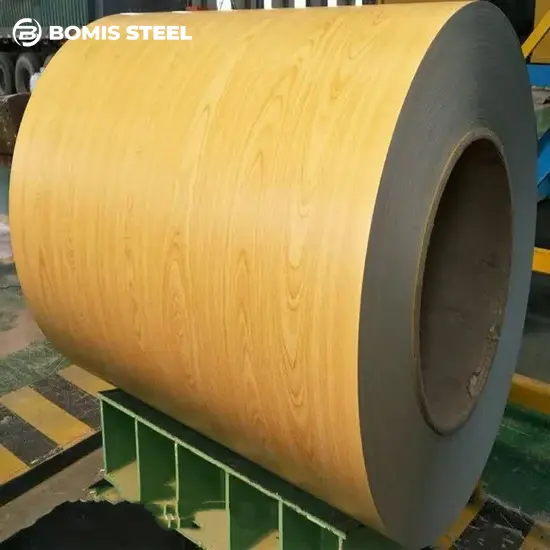
Our color lab maintains a library of 150+ wood grain patterns and can match custom samples. Color consistency across production batches is measured by spectrophotometer, with a target ΔE below 1.0. Salt spray, T-bend, impact, and MEK rub tests are run per batch before release.
ISO 9001 and ISO 14001 certified. Mill test certificates and third-party inspection through SGS or Intertek are available on every order. Mixed container loads combining multiple widths, thicknesses, or patterns are standard practice for our export clients.
Is the wood grain a printed coating or a laminated film?
It is a printed coating. Wood grain ink is roller-coated directly onto the steel, then sealed under a clear topcoat. It is not a PVC or PET film laminated on top. The printed approach gives better adhesion, no risk of film delamination over time, and a thinner total build-up that still handles bending and roll-forming without cracking.
Can I get the wood grain on both sides of the strip?
Yes. Single-sided wood grain (plain back) and double-sided wood grain are both available. Double-sided costs more but makes sense for applications where both faces are visible, like partition panels or hanging displays.
What is the difference between wood grain PPGI strip and wood grain PPGL strip?
The base substrate. PPGI uses hot-dip galvanized steel (zinc coated). PPGL uses galvalume steel (aluminum-zinc coated). The wood grain print and topcoat are the same on both. PPGL offers better cut-edge corrosion resistance, so it is preferred for outdoor or high-humidity applications. PPGI works well indoors and costs less. We can advise based on where the finished product will be used.
How does the wood grain hold up during roll forming and bending?
It holds up well as long as the coating system is spec’d correctly. The print and topcoat are formulated to flex with the steel through 180° bends and standard roll-forming profiles. For tight-radius bends below 2T, we recommend a test run with the actual tooling to confirm. The clear topcoat may show micro-crazing at extreme bend radii. This is cosmetic and does not expose bare steel, but it is worth validating against your acceptance standard.
Can you match a specific wood color or grain pattern?
Yes. We maintain a library of 150+ standard wood grain options. If you have a custom wood sample, laminate swatch, or Pantone reference, our color lab can develop a matching print plate. Custom pattern development typically adds 7 to 10 working days to the lead time and carries a one-time plate fee.
What is the minimum slit width?
20 mm. Below that, edge quality becomes harder to control on the slitting line. If your application needs something narrower, talk to us. It depends on the thickness and substrate combination.