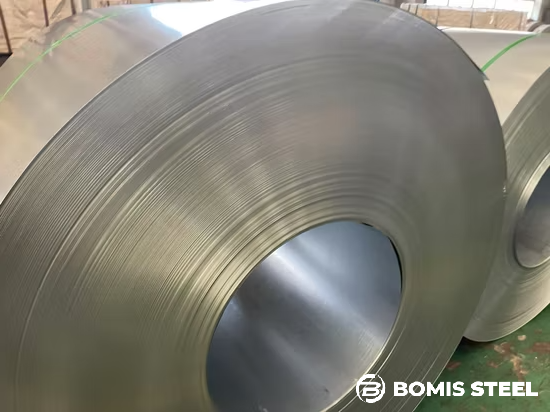
Electro galvanized steel — EG for short — is cold-rolled steel with a thin zinc layer plated on by electrolysis. The coating runs 5-15 µm: smooth, matte, no spangle. If the part lives indoors and has to look right, this is the sheet you’re after.
The difference from hot-dip starts on the surface. Electroplating deposits zinc at room temperature, so the coat comes out even and spangle-free — no crystalline pattern, no drips. Paint grips it well, and with phosphate pre-treatment you can skip the grinding and go straight to the paint line. For panels that sit in a showroom, that surface is the whole sale.
Formability is where EG earns its keep. Plating happens cold, so the base steel keeps its full mechanical properties — deep drawing, stamping, bending — and the coating flexes with the metal instead of cracking at the radius. Welding is clean too, with a fraction of the zinc fume you get from hot-dip. Coating weight runs 5-50 g/m² per side, typically 20-40 g/m², and because plating is set by current and time, it comes out the same batch after batch.
| Propriété | Valeur |
| Matériau de base | Cold-rolled steel — SPCC, SPCD, DC01-DC06 |
| Revêtement de zinc | 5-50 g/m² per side, typically 20-40 g/m² |
| Épaisseur | 0.3-3.0 mm |
| Largeur | 600-1,500 mm (up to 2,000 mm available) |
| Longueur | Cut to specification — coil or sheet |
| Traitement de surface | Chromated, phosphated, anti-fingerprint, oiled |
| Normes | JIS G3313 SECC/SECD/SECE, EN 10152, ASTM A879/A879M |
| Dureté | Soft, quarter-hard, half-hard, full-hard |
EG is a parts material. Anything that lives indoors and has to look decent gets spec’d in it — the zinc protects cut edges and small scratches, and the surface carries paint without complaints. Same sacrificial principle as hot-dip: the zinc corrodes first, the steel underneath stays. The protection window is shorter than HDG, so keep it under cover.
On the shop floor, EG handles exactly like cold-rolled steel — cut it, punch it, stamp it with standard tooling, no special tricks. Parts get complex, order SECD or SECE drawing grades. Welds run clean with regular resistance and arc methods, and parts heading to the paint line need no passivation removal — just degrease and coat. Deep drawing is no problem when the grade matches the part.
Export packing is straightforward — coils in anti-rust film, sheets in waterproof paper, steel-strapped on wooden pallets. A 20GP takes up to 25 tons depending on gauge. Need something different, just say — custom packing is on the table. We’ve shipped this grade for years; packing is routine.
A: Electroplating lays zinc down at room temperature — thin, smooth, spangle-free, 5-15 µm. Hot-dip dips steel in molten zinc — thick, 35-275 µm, visible spangle. EG suits indoor parts, HDG outdoor.
A: Three reasons. Surface — smooth and paint-ready, no grinding. Formability — the cold process keeps the base steel’s drawability, so deep-drawn parts hold shape. Cost — thinner coating means less zinc, and no outdoor-grade protection you don’t need.
A: Not on its own. 5-15 µm is too thin for direct outdoor exposure. Outside, go hot-dip at 35 µm and up, or top-coat the EG with paint or powder.
A: 1 g/m² of zinc is about 0.14 µm. Standard commercial EG at 20 g/m² per side is roughly 2.8 µm per side. Z275 hot-dip, 275 g/m² both sides, is about 19 µm per side.
A: Chromated (Cr³⁺, extra corrosion resistance), phosphated (better paint adhesion), anti-fingerprint (clear coat, keeps handling marks off), oiled (temporary rust protection). Default is chromated plus oiled — say otherwise at order time.
A: At the weld zone, yes — zinc burns off within 2-3 mm of the weld. Cosmetic surfaces may need touch-up. In enclosed assemblies the surrounding zinc keeps protecting the heat-affected zone.