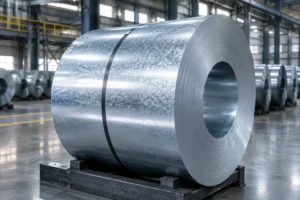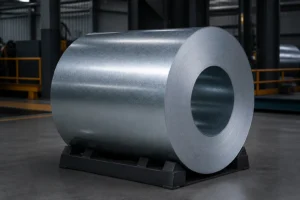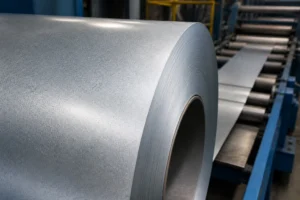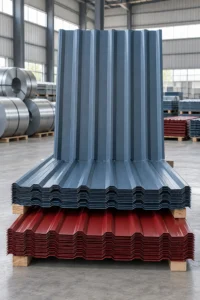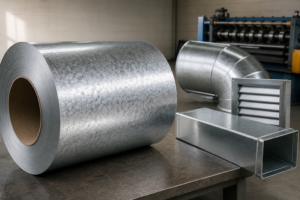

















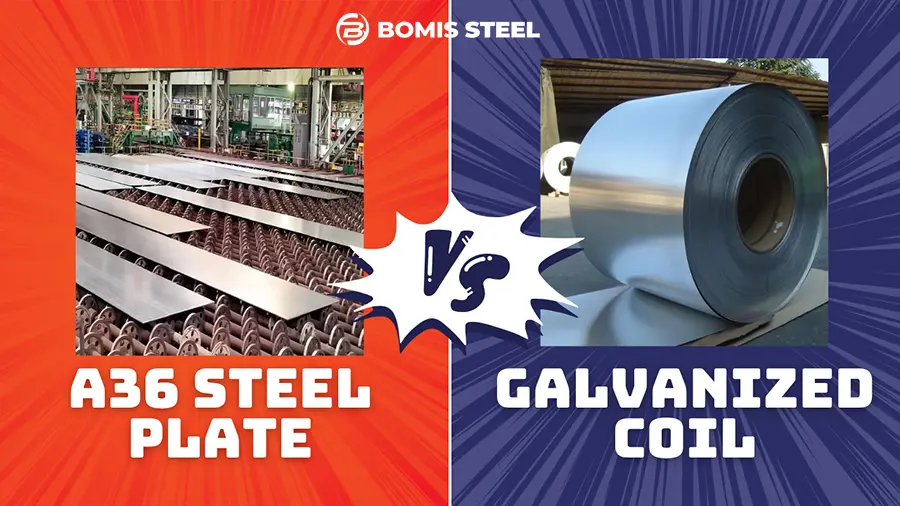
A36 steel plate is the most common structural carbon steel in North America. Walk onto any construction site and the I-beams, base plates, and gusset plates are almost certainly A36. But if your product is under 2 mm thick and needs corrosion resistance, raw A36 plate is probably the wrong starting point — a 2mm galvanized steel sheet offers the same rigidity with built-in corrosion protection. Here is how to decide between A36 plate and galvanized coil — and when each one makes sense.
What Is A36 Steel Plate?
A36 steel plate is a low-carbon structural steel defined by ASTM A36/A36M. The “36” refers to its minimum yield strength: 36 ksi, or roughly 250 MPa. Carbon content is capped at 0.26%, which keeps the material soft enough to weld without preheating and ductile enough to bend without cracking.
A36 steel plate is typically supplied hot-rolled, with a mill scale surface. Thickness ranges from a few millimeters up to 150 mm or more, depending on the mill. Common widths run 1200 mm to 2500 mm, with lengths cut to order.
It welds easily with standard MIG, TIG, and stick processes. It machines predictably. It is the cheapest certified structural grade you can buy. Those three facts explain why A36 steel plate moves more tonnage than any other structural grade.
A36 Steel Plate Chemical Composition
| Element | Content (%) |
|---|---|
| Carbon (C) | ≤ 0.26 |
| Manganese (Mn) | 0.60 – 0.90 |
| Phosphorus (P) | ≤ 0.04 |
| Sulfur (S) | ≤ 0.05 |
| Silicon (Si) | ≤ 0.40 (optional) |
| Copper (Cu) | ≥ 0.20 (when specified for atmospheric corrosion resistance) |
A36 Steel Plate Mechanical Properties
| Property | Value |
|---|---|
| Yield Strength | ≥ 36 ksi (250 MPa) |
| Tensile Strength | 58 – 80 ksi (400 – 550 MPa) |
| Elongation (200mm) | ≥ 20% |
| Elongation (50mm) | ≥ 21% |
| Modulus of Elasticity | ~200 GPa |
| Brinell Hardness | 119 – 162 HBW |
The combination of moderate strength and good ductility makes A36 steel plate suitable for seismic zones — it deforms before it fractures, which is exactly what you want in an earthquake.
Where A36 Steel Plate Belongs
A36 steel plate is a heavy-gauge structural material. It belongs in:
- Building columns, beams, and structural frames
- Bridge components and highway infrastructure
- Heavy machinery bases and mounting plates
- Storage tanks (non-pressurized) and hoppers
- General fabrication — anything cut, drilled, welded, and bolted
What A36 steel plate does not do well is resist corrosion. Bare A36 left outdoors will show surface rust within weeks. In humid, coastal, or industrial environments, unprotected A36 steel plate deteriorates fast.
A36 Steel Plate vs A516: Different Applications
Buyers sometimes cross-shop A36 steel plate with ASTM A516. They are not interchangeable.
| Feature | A36 Steel Plate | A516 (Gr 60/65/70) |
|---|---|---|
| Type | Structural carbon steel | Pressure vessel steel |
| Applications | Buildings, bridges, fabrication | Boilers, storage tanks, pressure vessels |
| Strength | Standard structural | Higher tensile strength |
| Temperature Resistance | Moderate | Excellent (low and high temp) |
| Notch Toughness | General use | Optimized for pressure containment |
| Cost | More economical | Higher |
Can You Galvanize A36 Steel Plate?
Yes. A36 steel plate hot-dip galvanizes well. The silicon content is low enough (≤ 0.40%) that the zinc bonds evenly to the surface. Once galvanized, A36 steel plate gains decades of corrosion protection.
But here is the practical problem: if you are fabricating from A36 steel plate, you cut, drill, and weld first, then send the finished assembly to the galvanizer. That adds a separate production step, transport to and from the galvanizing plant, and a lead time of days to weeks depending on the galvanizer’s queue.
When Galvanized Coil Beats A36 Steel Plate
For sheet metal products under 2 mm — roofing sheets, wall cladding, roll-formed profiles, ducting, appliance housings — starting with bare A36 steel plate and post-galvanizing is almost never the economical path. You pay for the plate, pay to fabricate it, then pay to galvanize the finished parts. Meanwhile, a competitor who bought pre-coated coil ran it straight through a roll-former and shipped the same day.
The better starting point for thin-gauge products is:
- Galvanized steel coil (GI): Zinc-coated at the mill. No post-fabrication galvanizing. Thickness from 0.13 mm. Available in zero spangle, minimized spangle, regular spangle, and large spangle finishes. Z30 to Z275 coating weights.
- Galvalume coil (GL / Aluzinc): Aluminum-zinc alloy coating. Outperforms plain GI in humid and coastal environments. The same gauge carries better corrosion protection.
- Pre-painted galvanized coil (PPGI): GI or GL substrate with a factory-cured PE, SMP, HDP, or PVDF color coat. No painting on site. No color variation between batches. RAL-matched to your specification.
Each of these arrives ready to uncoil, profile, cut, and install. The zinc or Al-Zn coating is already metallurgically bonded. The color coat is already cured. For manufacturers processing thin-gauge steel into finished building products, the coated coil skips two entire production steps compared to the A36 steel plate route.
Decision Table: A36 Steel Plate or Galvanized Coil?
| Your Project | Use This | Why |
|---|---|---|
| Structural beam, column, or heavy plate (>6 mm) | A36 steel plate | Strength and weldability at the lowest cost |
| Thin-gauge roofing or cladding (0.13–2.0 mm) | Galvanized or galvalume coil | Coating already applied; no post-processing |
| Visible exterior panels needing color | PPGI coil | Factory color coat; consistent from coil to coil |
| Coastal or high-humidity environment | Galvalume coil or PVDF-coated PPGI | Al-Zn alloy handles salt air better than zinc alone |
| Fabricated part that needs corrosion resistance | A36 steel plate + post-galvanize | Fabricate first, then batch-galvanize the assembly |
The Bottom Line
A36 steel plate is not going anywhere. It welds easily, costs less than any other certified structural grade, and handles heavy structural loads without complaint. For columns, beams, bridge components, and thick fabricated assemblies, it is still the default choice for good reason.
But if your product is sheet metal — roofing, cladding, roll-formed profiles — do not buy A36 steel plate and galvanize after the fact. Buy the coating on the coil. The math is better, the lead time is shorter, and the coating is more uniform than any batch process can achieve.
BOMIS supplies galvanized, galvalume, and pre-painted steel coils to manufacturers across Southeast Asia, the Middle East, and Africa. If you know what substrate and coating your product needs, tell us your specification and we will quote within 24 hours.