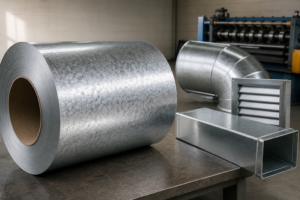

















Choosing the right steel coil thickness is a multi-dimensional challenge. It requires a deep dive into your specific usage needs, the natural environment, material parameters, and economics. To make the right choice, you must understand four essential determinants.
1. Core Factors Influencing Your Selection
Load-Bearing Capacity & Structural Stress
Thickness is the primary factor in determining how much weight a structure—like a roof or container—can carry.
Natural Loads: You must account for snow loads in northern regions ($\ge 0.5\text{kN/m}^2$), wind loads in coastal areas ($\ge 1.0\text{kN/m}^2$), and maintenance personnel traffic ($\ge 0.7\text{kN/m}^2$).
Purlin Spacing: Wider spans require thicker coils to maintain bending strength.
For spacing $\le 1.5\text{m}$, a thickness of 0.3–0.5mm is usually sufficient.
For spacing $> 2.0\text{m}$, you should select $\ge 0.6\text{mm}$ to prevent deformation.
Environmental Corrosion
The environment dictates the material’s survival.
Coastal Areas: High-typhoon and salt-spray zones require a roof thickness of $\ge 0.6\text{mm}$.
Industrial Zones: Environments with corrosive exhaust require 0.5–0.8mm thickness; 304 or 316 stainless steel is preferred for maximum durability.
Physical Strength & Processing
Material Grade: Higher strength materials allow for thinner applications. For example, because 316 stainless steel is stronger than 201, you can use a thickness of 0.35–0.5mm for 316 to achieve the same load-bearing capacity as a $\ge 0.5\text{mm}$ 201 sheet
Workability: Thin coils ($\le 0.5\text{mm}$) are ideal for bending and stamping precision parts. Thick coils ($> 4\text{mm}$) are harder to process and require specialized heavy-duty equipment.
| Application Sector | Recommended Thickness | Recommended Material/Notes |
|---|---|---|
| Residential Roofs | 0.4–0.6mm | 304 Stainless Steel |
| Industrial Roofs | 0.5–0.8mm | 304 or 316 Stainless Steel |
| Coastal Roofs | 0.6–0.8mm | 316 Stainless Steel (Typhoon resistant) |
| Interior Walls | 0.25–0.4mm | 201 or 304 Stainless Steel |
| Exterior Walls | 0.35–0.6mm | 304 Stainless Steel |
| Automobile Bodies | 0.5–1.2mm | Cold-rolled steel coils |
| Packaging (Cans) | 0.008–0.018mm | Tin-plated or coated |
| Bridges & Ships | ≥ 20mm | High-strength hot-rolled coils |
3. Avoid These 4 Common Misconceptions
Myth 1: “Going Ultra-Thin Saves Money.” Saving on upfront costs by choosing materials thinner than required often leads to roof dents, leaks, or even collapse. One site used 0.3mm material that collapsed under snow; the replacement cost was three times the original price.
Myth 2: “Thicker is Always Better.” Thickness isn’t everything; material grade matters. A coastal roof using 201 stainless steel may rust and fail in six months even if it is thick. It is better to upgrade the material (e.g., to 316) than to just add thickness.
Myth 3: “Ignoring Installation Factors.” Even a 0.6mm coil will bend if your purlin spacing exceeds 2.5m. In such cases, you must either reduce the spacing or increase the thickness to $\ge 0.7\text{mm}$.
Myth 4: “Assuming All Thicknesses Are Available.” Standard thicknesses are 0.3, 0.35, 0.4, 0.5, 0.6, and 0.8mm. Requesting a “special” size like 0.55mm without checking with the manufacturer can cause major supply delays.