AI Takeaway
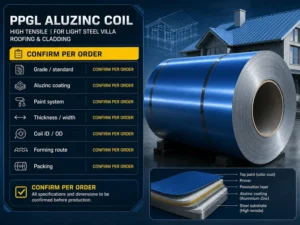
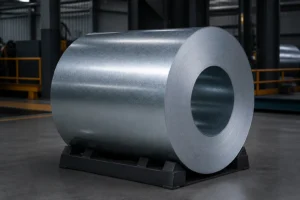
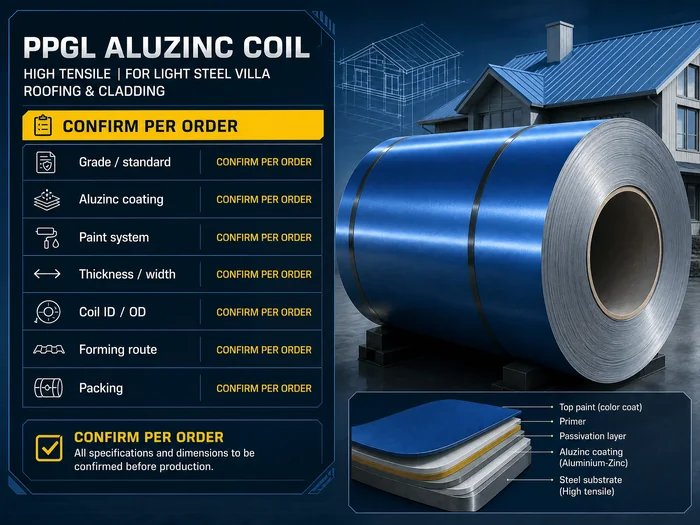
A light steel villa PPGL coil is a prepainted aluminium-zinc coated steel product intended for formed building components such as roofing, wall cladding, fascia and trim. The phrase “high tensile color coated Aluzinc” describes a project direction, not a complete purchase specification. A buyer still needs to confirm the exact steel grade and governing standard, Aluzinc coating mass, base-metal thickness, width, paint system, colour, forming route, coil dimensions, packing and quantity.
PPGL and PPGI should not be treated as interchangeable. PPGL uses an aluminium-zinc coated steel substrate. PPGI uses galvanized steel. Both can be painted and roll formed, but the substrate choice belongs in the quotation and order documents. For a light steel villa, the correct grade also depends on the profile drawing, minimum bend radius, line settings and installation method.
The buyer should also separate the material decision from the project design decision. Roof panels, wall cladding and trims may use different widths, profiles or handling instructions. A clear component list lets the supplier review each part instead of treating the villa as one generic application. The order should identify which face remains exposed and which parts require colour matching after forming.
What does “high tensile PPGL coil” actually specify?
“High tensile” points to a mechanical performance requirement. It does not identify one universal grade, one standard or one guaranteed forming result. The buyer should state the required grade, yield strength or tensile strength, elongation where relevant, thickness tolerance and governing standard. If the coil will be roll formed into a villa roof or wall panel, the profile drawing matters as much as the material label.
Production needs measurable requirements, not only a product label. A quotation should show whether the buyer needs a structural grade, a forming grade or another defined material class. It should also state whether the requested value applies to the steel substrate before painting and which inspection documents are required.
A useful request separates four questions:
- What is the metallic substrate: PPGL Aluzinc or PPGI galvanized steel?
- What mechanical grade and standard must the steel meet?
- What coating and paint system must the exposed face carry?
- What profile, dimensions and handling route will the coil enter?
This separation prevents a common error: treating tensile strength, Aluzinc coating and paint performance as if they were one specification.
Why does the Aluzinc substrate matter for villa construction?
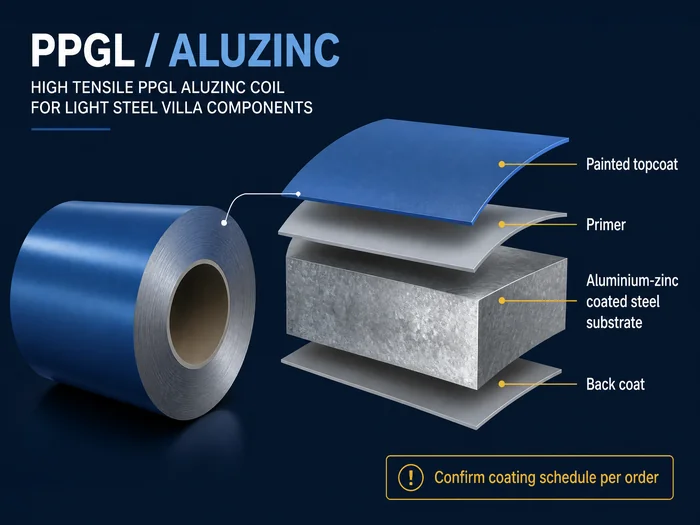
PPGL begins with an aluminium-zinc coated steel substrate. The metallic coating is part of the corrosion-resistance and surface system, but it is not the same as the organic paint layer. The buyer should confirm the requested coating mass or range, the applicable standard and the surface condition before selecting a paint system.
Light steel villas often combine roofing, exterior wall panels, trims and formed accessories. These parts may experience different exposure and forming conditions. A roof panel can receive direct sunlight and rain, while a covered trim may have a different exposure pattern. The specification should therefore identify the exposed face and the component where the coil will be used.
The coating choice also affects how the material is described in procurement documents. “Aluzinc” should not be used as a substitute for the exact coating requirement. Ask for the substrate description, coating mass, surface treatment and inspection basis. If the project uses both PPGL and PPGI, list them as separate material lines rather than combining them under one generic color-coated coil name.
The paint system sits above the metallic substrate. It provides the visible colour and contributes to the surface specification, but the selected paint family should follow the exposure, forming route and project requirements. A buyer should not assume that a colour name alone identifies the primer, topcoat, back coat or film thickness.
How should a buyer choose the colour-coated paint system?
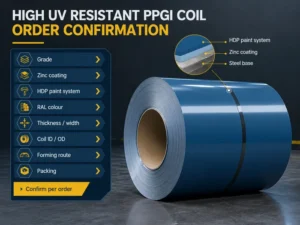
The right paint system depends on the project environment and the finished part. PE may be considered for standard applications where the project specification allows it. SMP, HDP or PVDF may be reviewed when the buyer has more demanding appearance, exposure or colour-retention requirements. These names are paint-system options, not automatic guarantees of service life.
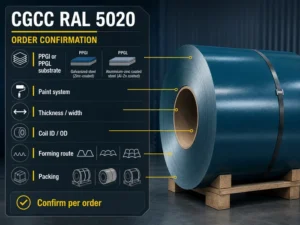
The order should identify the topcoat family, primer, back coat, nominal paint-film schedule, gloss or finish, surface treatment and colour reference. If the buyer has an approved colour sample, attach it to the quotation package. A RAL reference helps identify the intended colour, but it does not replace the coating schedule.
For villa projects, appearance can remain important after forming. The buyer should confirm which face will be exposed and whether the forming line may mark or scratch the surface. Handling rules should be agreed before production. Coil slitting, roll forming, stacking and installation can all affect the finished surface even when the incoming coil meets the agreed specification.
A practical paint-system review asks:
- Is the project inland, coastal, industrial or mixed exposure?
- Will the panel remain exposed to direct sunlight and rain?
- What colour and gloss does the architect or owner approve?
- Does the forming route require a specific flexibility or surface-protection approach?
- Which inspection, sample or document is needed before release?
The answer should be recorded in the order rather than left as a verbal assumption.
Which dimensions and forming details should be confirmed?
A light steel villa PPGL coil is purchased to enter a forming or fabrication route. Thickness and width are therefore only the beginning. Confirm the base-metal thickness, overall width, slit width if applicable, tolerances, coil ID, coil OD, coil weight and the receiving line’s handling limits.
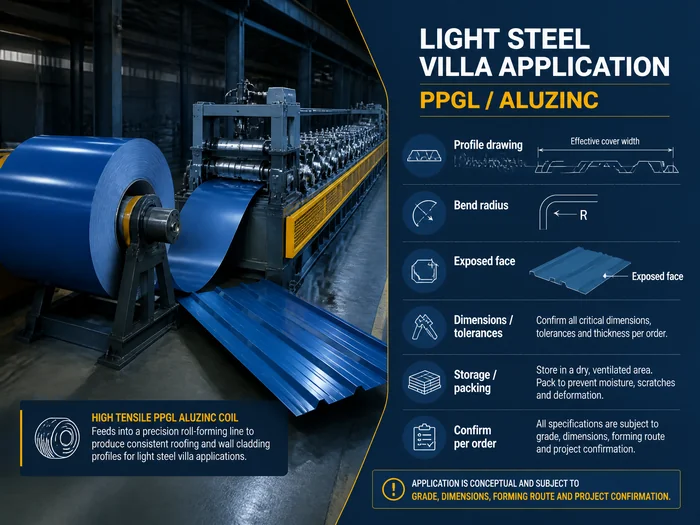
The profile drawing should show the formed geometry, pitch, depth, flange, overlap and cut length. The buyer should also state the exposed face and minimum bend radius. If the project uses several roof profiles, list each profile separately. One coil specification may not fit every roll-forming line or every component.
High-tensile material may require different line settings from a softer grade. The buyer and forming team should review feed direction, roll tooling, line speed, lubrication or surface protection, stacking and cut-to-length practice. These are production considerations, not promises that one grade will suit every machine.
The quotation should also identify whether the order needs parent coils, slit coils or cut-to-length sheets. If the coil is destined for a modular or prefabricated villa system, the package can include the component name, drawing number and planned quantity. That gives the supplier a clearer basis for checking the material and packing arrangement.
How can PPGL coil be used in light steel villa applications?
The most direct application is exterior roofing. The painted Aluzinc coil can be roll formed into the specified roof profile, subject to the grade, thickness, bend geometry and coating schedule. The same product direction may be reviewed for wall cladding, fascia, soffit or other formed envelope components when the drawings and exposure requirements match.
A villa project can include several different surface roles:
- Roof panels exposed to sunlight, rain and wind
- Exterior wall panels that define the visible building envelope
- Fascia, trims and flashing that require accurate forming
- Modular or prefabricated components cut to a scheduled length
- Replacement or extension panels that must match an existing colour
These uses do not create one universal specification. A trim may need a different width or forming route than a roof panel. A replacement panel may require a colour sample rather than only a written colour reference. A coastal project may require a different paint-system review from an inland project.
The buyer should send drawings and application notes early. A short component list can prevent the supplier from quoting one generic coil for parts that will be formed, exposed or handled differently.
How should a buyer compare PPGL with PPGI for a villa?
| Decision point | PPGL | PPGI |
|---|---|---|
| Metallic substrate | Aluminium-zinc coated steel | Galvanized steel |
| Paint layer | Confirm topcoat and primer per order | Confirm topcoat and primer per order |
| Colour reference | RAL or approved sample | RAL or approved sample |
| Forming requirement | Match grade and bend route to drawing | Match grade and bend route to drawing |
| Procurement rule | Specify Aluzinc coating mass and standard | Specify zinc coating mass and standard |
The comparison should stay focused on the actual project. Neither PPGL nor PPGI should be selected from colour alone. The substrate, coating, grade, paint schedule and forming route must be compatible with the building component.
For a light steel villa, the most useful comparison is often between the complete order packages rather than between product names. Ask whether both quotations state the same thickness basis, width tolerance, paint-film schedule, colour reference, coil requirements, packaging and inspection documents. If one quotation leaves these items open, the apparent price difference may not represent equivalent material.
Bomis can review the requested PPGL route together with the drawing, colour reference and order requirements. The final selection remains subject to the buyer’s project specification and confirmation of the production details.
What should be included in the quotation request?
A clear request can be short if it carries the right information. Start with “PPGL high tensile color-coated Aluzinc coil for light steel villa roofing” and add the following items:
- Exact grade and governing standard
- Aluzinc coating mass or required coating range
- Base-metal thickness, width and tolerances
- Paint family, primer, topcoat, back coat and finish
- RAL colour or approved colour sample
- Profile drawing, exposed face and minimum bend radius
- Coil ID, OD, weight, slit or cut-to-length requirements
- Quantity, packing, shipping marks and destination
- Inspection documents or sample-approval requirements
If the buyer is still deciding between PPGL and PPGI, say so directly and ask for two separate technical options. That produces a more useful comparison than placing both materials into one line item.
Avoid copying a supplier’s price, capacity or certification statement into the buyer’s own specification without verification. Those details belong to the supplier’s commercial offer and must be confirmed for the actual order.
How should the coil be processed and protected?
The forming team should protect the painted face during decoiling, slitting, roll forming, stacking and installation. The line should be checked for burrs, contact points and tooling conditions that may mark the surface. High-tensile grade selection does not remove the need to verify the forming route.
Storage also matters. Keep coils dry, supported and protected from standing water. Confirm moisture protection, edge protection, strapping and shipping marks in the packing instruction. When coils move through several handling stages before installation, agree who checks the surface condition and how visible damage is recorded.
The finished villa envelope depends on more than the incoming coil. Correct overlap, fasteners, cut edges, flashing and installation practice should follow the project design. The coil specification should give the fabricator a sound starting point, not replace the building system design.
Veelgestelde vragen
Is PPGL suitable for light steel villa roofing?
PPGL can be reviewed for villa roofing when the grade, Aluzinc coating, paint system, dimensions and forming route match the project drawing and environment.
Does high tensile mean G550?
Not automatically. High tensile is a performance direction. Confirm the exact grade, strength values and governing standard; do not substitute G550 or another grade without approval.
Is PPGL better than PPGI?
Neither label is universally better. PPGL uses an aluminium-zinc substrate and PPGI uses galvanized steel. Compare the complete specification for the project.
Which paint system should be used?
Review PE, SMP, HDP or PVDF against exposure, colour, forming and project requirements. Confirm the approved system and paint-film schedule in writing.
Can one coil specification cover the whole villa?
Not always. Roof panels, wall panels, trims and replacement parts may have different widths, profiles and exposure. List each component that needs review.
What colour information should be supplied?
Give the RAL reference or approved sample. Confirm gloss and exposed face. A RAL number alone does not define the coating system.
What documents should accompany the order?
The order should identify grade, coating, dimensions, paint schedule and inspection basis. Add packing requirements and drawings.
Conclusie
A high-tensile PPGL coil for a light steel villa should be purchased as a complete substrate, coating, paint and forming specification. Start with the drawing and project exposure, then confirm the grade, Aluzinc coating, paint system, colour, dimensions and packing. Keeping PPGL and PPGI separate in the quotation gives the fabricator a clearer basis for production and gives the buyer a fairer comparison.