
The safety, waterproofing, and stain resistance of building materials (roof panels and exterior wall panels) are all requirements for steel used in construction.
For the end owners of buildings, safety and service life are paramount. For design firms, service life, load-bearing capacity, and appearance are more important. For manufacturers of precast wall and roof panels, the processability of color-coated steel sheets (surface hardness, wear resistance, sheet shape, and steel strength) is the primary requirement.
Of course, the quality of color-coated steel sheets mainly depends on their production; however, improper processing and installation equipment and methods can also cause damage to the final product’s appearance and service life to varying degrees.
The performance indicators of color-coated steel sheets include:
Base plate: yield strength, tensile strength, elongation
Coating: coating weight, adhesion
Coating layer: color difference, gloss, T-bend, impact, hardness, chalking resistance, damp heat resistance, etc.
Surface: visible surface defects, etc.
Sheet shape: tolerances, unevenness, etc.
1. Steel Grade
The load-bearing capacity (wind load, snow load on buildings, construction personnel and machinery), the span of the building, and the design of the distance all depend on the strength of the steel sheet. For color-coated and galvanized steel sheets used in building envelope structures, there are corresponding standards both domestically and internationally. Examples include China’s GB/T12754-2006, the US’s ASTM653 and ASTM792, Japan’s JISG3302 and JISG3321, and Europe’s EN10215 and EN10147. Steel grades are broadly classified as CO (general commercial grade), DO (general stamping grade), HSS (high-strength structural steel), and FH (fully hardened steel). C0 is currently the most widely used grade. For example, Baosteel’s TDC51 grade has a yield strength between 260-320 MPa and a tensile strength between 350-400 MPa, which is slightly higher than that of structural steel.
DO (Dielectric-Coated) steel is mainly used in doors, windows, and pipes because most building-grade color-coated steel sheets are roll-formed or composite-clamped, and the stamping performance requirements are not high.
HSS (High-Strength Structural Steel): According to the European standard HSS, it can be divided into 4-5 different strength grades. However, since ordinary CQ grade materials can replace low-strength HSS steel, the most commonly used grades in the market are those with yield strengths of 280 MPa and 345 MPa. Baosteel’s TS280GD and TS350GD are these two grades.
Compared to ordinary CO, HSS steel has several advantages: 1) Due to its lower yield strength, this steel has better fire resistance and seismic resistance. 2) For thicker steel plates, it can be used to manufacture large-span arched plates. 3) For general exterior wall and roof panel types, it can be appropriately thinned compared to CO material, thus saving material consumption.
All-hardened steel: This type of steel increases the yield strength of the steel plate by controlling the annealing temperature. According to international standards, the yield strength is ≥550MPa, and the tensile strength is >570MPa. This type of material has high strength and low elongation, making it suitable for shallower formed steel plates, greatly saving material usage.
2. Coating Selection
The coating is designed to ensure the durability and corrosion resistance of the building. Different applications can meet their service life by selecting different coatings, layers, and thicknesses. Currently, the commonly used coatings for architectural color coatings are hot-dip galvanized and hot-dip aluminized zinc. For color coatings, the application areas of the two substrates are not significantly different. In relatively acidic environments, aluminized zinc substrates are a better choice. However, for use in humid or alkaline environments, the superior cut-edge corrosion resistance of galvanized substrates becomes apparent.
Regarding coating thickness, the general requirements for roof panels and exterior wall panels are: hot-dip galvanized >180g/m² (approximately 26µm), and aluminized zinc ≥100g/m² (approximately 27µm). For use in heavy industrial areas or near the sea, relevant international associations have minimum zinc coating requirements, such as ECCA standards and Australian standards requiring a zinc coating weight >275g/m² (approximately 38µm) and an aluminized zinc coating 2150g/m² (approximately 40µm).
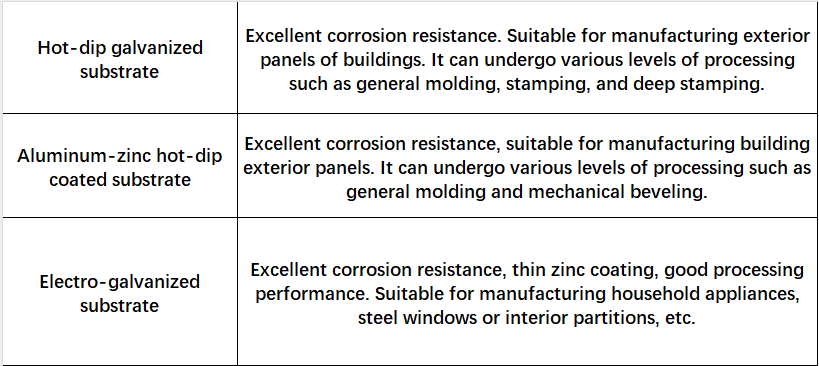
2.2 Coating The coating must meet user requirements for color and durability. For processors, processing performance must also be met. Therefore, the type, color, gloss, and coating thickness of the coating must be specified when ordering.
Commonly used topcoat types for coil steel include polyester (PE), polyurethane (PU), silicone-modified polyester (SMP), fluorocarbon (PVDF), and high-weather-resistant polyester (HDP). Primer and backcoat types include epoxy (EP), polyester (PE), and polyurethane (PU).
Color selection primarily considers matching the surrounding environment and the user’s preferences. However, from a technical standpoint, lighter colors have stronger reflectivity and less contrast after chalking. With proper cleaning and maintenance, they will have a longer service life and a more aesthetically pleasing appearance.
Regarding gloss, gloss loss is the earliest phenomenon to occur in outdoor use of color-coated steel sheets, especially for high-gloss products where initial gloss loss is rapid. Once the gloss drops to around 20, it will remain for a relatively long time. This phenomenon will appear after several months of use. Therefore, outdoor architectural color-coated steel sheets are generally low-gloss.
Furthermore, products from the same color-coating manufacturer should be used in the same building. Because the coating of color-coated steel sheets from different manufacturers exhibits varying rates of chalking after a certain period of outdoor use, even if buildings appear uniform upon completion, different colors will appear over time, affecting their aesthetics.
Microscopically, the coating is a porous structure. Water and corrosive media (such as chloride ions) in the air can penetrate through weak points in the coating, causing under-film corrosion, leading to blistering and peeling. Furthermore, even with the same coating thickness, a secondary coating is denser than a primary coating.
According to relevant corrosion test results, a front coating of at least 20µm is necessary to effectively prevent the penetration of corrosive media. PVDF products require even thicker coatings. The requirements for the back coating depend on the application; sandwich panels only require one adhesive primer layer, while formed steel sheets, due to the corrosive indoor environment, require two layers with a thickness of at least 10µm.