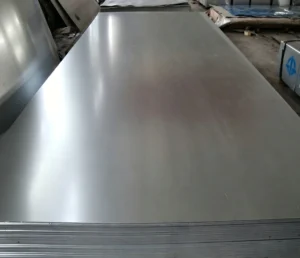

















Common sheet metal thicknesses include roughly 0.6–3 mm for many fabrication jobs, while familiar North American sheet sizes include 4 × 8, 4 × 10, and 5 × 10 feet. A 2 mm sheet sits within that working range, but its gauge equivalent depends on the metal—not one universal conversion. Understanding thickness, material, and stock dimensions together helps you specify the right product without accepting an unsuitable substitute.
From Our Export Dispatch Log: Right now, 1,517 tons of sheet and coil steel—split across seven individual customer lots—are scheduled to arrive at the Port of Buenaventura, Colombia on November 29 aboard M/V Zhong Chang Hong Sheng (V.A2676). Looking at the order specs behind multi-lot shipments like this one, 2.0mm (approx. 14-gauge) consistently ranks among our highest-volume requests, bridging the gap between thin, bendable sheet metal and heavy structural plate.

Whether you are stocking a distribution warehouse or quoting a fabrication run, here is a clear breakdown of the most common sheet metal thicknesses, standard sheet sizes, and typical applications for 2mm steel sheets.
What are the most common sheet metal thicknesses?
Common sheet metal thicknesses span thin stock around 0.5–0.6 mm through heavier fabrication material around 3 mm and beyond. Frequently encountered mild-steel options include approximately 0.61 mm, 0.91 mm, 1.21 mm, 1.52 mm, 1.90 mm, and 2.66 mm, corresponding to 24, 20, 18, 16, 14, and 12 gauge. These are nominal chart values, not a guarantee that every supplier stocks every option.
Metric specifications also use direct dimensions such as 1 mm, 1.5 mm, 2 mm, and 3 mm. When a drawing calls for one of these, ask for that thickness rather than assuming a nearby gauge is interchangeable. Supplier catalogs may organize material by gauge, decimal inches, or millimeters, so compare the actual dimensions before approving a substitution.
The boundary between sheet and plate needs similar care. For aluminum, a common commercial dividing point is 0.250 inch, or 6.35 mm; other product descriptions and specifications may use different conventions. Treat “sheet” as a product category, not a substitute for an explicit thickness requirement.
Gauge numbers need a material-specific chart
Gauge is a thickness designation, not a measurement unit. Higher gauge numbers generally indicate thinner material, but the steps are not a simple, uniform sequence. You cannot reliably calculate a missing value by subtracting the same amount at every gauge.
Different sheet metal types also follow different gauge tables. Historical conventions produced separate scales for steel and nonferrous metals, while galvanized steel has its own values that account for coating. The practical consequence is straightforward: always pair the gauge number with the material.
The following comparison shows how much that distinction matters. Values are approximate nominal thicknesses in millimeters; actual material remains subject to the applicable tolerances.
| मापक | Mild steel | Stainless steel | जस्ती स्टील | एल्यूमिनियम |
|---|---|---|---|---|
| 24 | 0.607 | 0.635 | 0.701 | 0.511 |
| 20 | 0.912 | 0.953 | 1.005 | 0.812 |
| 18 | 1.214 | 1.270 | 1.311 | 1.024 |
| 16 | 1.519 | 1.588 | 1.613 | 1.291 |
| 14 | 1.897 | 1.984 | 1.994 | 1.628 |
| 12 | 2.657 | 2.778 | 2.753 | 2.053 |
Rounded conversions from supplier gauge charts; minor rounding differences occur between published tables.
Once you have the actual thickness, unit conversion is straightforward: divide millimeters by 25.4 to obtain inches, or multiply inches by 25.4 to obtain millimeters. Convert the dimension—not the gauge number.
What gauge is a 2 mm sheet?
A 2 mm sheet is approximately 0.07874 inch thick. It is close to 14-gauge stainless or galvanized steel, falls between 14- and 13-gauge mild steel, and is close to 12-gauge aluminum. None of those approximate equivalents automatically replaces a specified 2.00 mm nominal thickness.
In particular, 2 mm mild steel is not 16 or 17 gauge. Those mild-steel thicknesses are approximately 1.52 mm and 1.37 mm, respectively—noticeably thinner than the requested material. Confusing these designations can leave a purchased sheet outside the intended specification.
For purchasing, use wording such as “2.00 mm nominal thickness, material grade as specified, tolerance to be confirmed.” If the supplier offers an imperial alternative, compare its thickness and tolerance with the drawing before accepting it. A rounded verbal description such as “about two millimeters” is not enough for a close-fitting assembly.

Standard sheet sizes and cut-to-size options
Common North American sheet metal sizes include the following width-by-length dimensions. Availability varies with material, grade, thickness, and supplier; a familiar size is not a promise of local stock.
| Sheet size | Dimensions in inches | Metric equivalent, rounded |
|---|---|---|
| 3 × 8 ft | 36 × 96 | 914 × 2,438 mm |
| 4 × 8 ft | 48 × 96 | 1,219 × 2,438 mm |
| 4 × 10 ft | 48 × 120 | 1,219 × 3,048 mm |
| 5 × 10 ft | 60 × 120 | 1,524 × 3,048 mm |
These sizes are useful planning references, not finished-part dimensions. Before ordering, ask your fabricator to check the cutting layout against its usable machine area, edge allowance, and spacing between parts. Larger sheets may accommodate more components, but the best choice depends on the actual layout and handling arrangements.
For small quantities, ask about cut-to-size blanks rather than automatically buying a full sheet. Specify the required blank dimensions and dimensional tolerance, and clarify whether the supplied edges need further finishing. Cut-to-size services are available for materials including aluminum and stainless steel.
Material choice changes the decision
Thickness alone does not define performance. Grade, temper, corrosion exposure, and forming requirements help determine whether a material suits the part. Consider these differences before treating equal-thickness sheets as interchangeable.
- Mild steel: A practical option for painted enclosures, frames, and brackets. Include corrosion protection in the specification when exposure demands it; increasing thickness does not replace a suitable finish.
- Galvanized steel: Its zinc coating provides corrosion protection. Confirm coating requirements as well as thickness, particularly when the part will be cut or otherwise fabricated after purchase.
- Stainless steel: Often selected for corrosion resistance, cleanability, and appearance. Specify grade and finish rather than simply requesting “stainless,” especially for food-processing or exposed decorative components.
- एल्यूमिनियम: Useful when weight matters, but alloy and temper affect fabrication. A bend suitable for one aluminum grade may crack another, so confirm those details before releasing the drawing.
How should you choose thickness for the application?
Choose thickness from the part’s required performance, then confirm that the selected material can be manufactured with the intended geometry. A gauge chart establishes dimensions; it does not establish allowable load, resistance to denting, or suitability for a particular unsupported span. Material, thickness, bend radius, and feature placement must be considered together.
For an enclosure, bracket, or formed panel, review these points with the fabricator:
- Define the service conditions. Describe loads, exposure, mounting points, and acceptable movement instead of selecting thickness by appearance alone.
- Check bends and flanges. Minimum flange length depends on material, thickness, bend radius, and tooling. A short return may need redesign rather than thicker stock.
- Review holes near bends. Nearby features can distort during forming. Confirm their position before finalizing the flat pattern.
- Confirm hardware compatibility. Inserts need suitable material thickness and grip; choosing fasteners after fabrication can restrict your options.
Application labels alone are insufficient. An HVAC panel, automotive replacement panel, and roofing component each need a project-specific specification rather than a generic recommendation to use 2 mm. Where an existing drawing or approved system defines the material, start there and have proposed changes reviewed.
Order by specification, not shorthand
Before requesting a quote, put the material grade, nominal thickness, tolerance, width, length, quantity, and finish on one clear order line. Add any coating, protective-film, grain-direction, or edge requirements that matter to the finished part. Ask suppliers to identify substitutions explicitly rather than silently replacing a metric thickness with a nearby gauge.
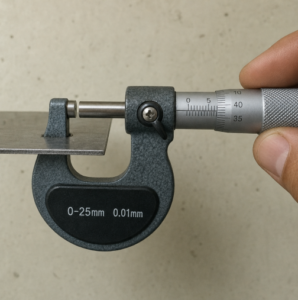
On receipt, compare the documentation with the order and measure thickness with suitable equipment. Sheet-metal micrometers are designed for this task, including deep-throat models that reach farther into a sheet.
The takeaway is simple: specify thickness directly, use the correct material-specific gauge chart, and confirm the available sheet dimensions before committing to the design. For a 2 mm requirement, keep “2.00 mm nominal” visible throughout quoting, purchasing, and fabrication.