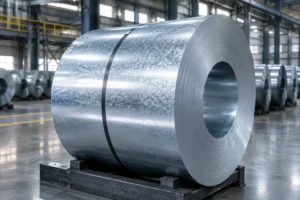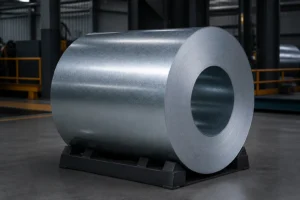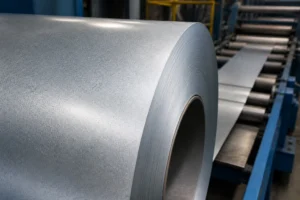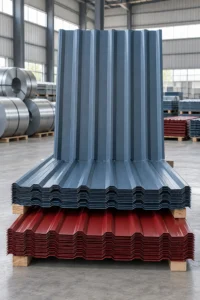





Buyers in South America are increasingly favoring AZ150 Galvalume roofing systems. AZ150 Galvalume is a preferred roofing material for South American procurement managers, while Galvalume alloys have become a baseline for regional construction. From South America’s humid interior to the salt-saturated regions on the coast, AZ150 performs exceptionally well in all South American climates.
Galvalume’s growing popularity represents a shift of major importance in the focus of global steel exporters. For modern commercial construction, advanced performance coatings are being relied on more and more. The primary driver for this reliance is data that supports the notion that commercial assets are made more durable and survivable through the use of high-performance coatings. These systems have a history of performing well in extreme environments. Industry reports confirm this trend is grounded in measurable, long-term field data.
What Makes AZ150 Different: The Technical Breakdown
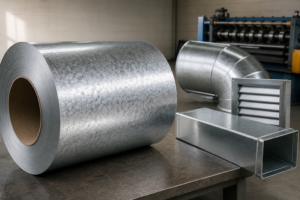
The name AZ150 refers to a coating that is a continuous hot-dip Galvalume of 150 g/m². The Galvalume alloy contains aluminum and zinc and a small percentage of silicon which provide corrosion resistance. Moving from AZ100 to AZ150 involves only small costs for greater roofing and coating system performance. Galvalume systems can be a competitive advantage in the Amazon basin or the Andes.
Galvanized Iron (GI) roofing systems contain a heavier coating compared to Galvalume, but are aluminum-free. In an accelerated salt spray test, AZ150 will even outperform GI systems that contain a heavy zinc coating.
How South American Climates Put Metal Roofing to the Test
Manaus, Santiago, and Buenos Aires have different climates, yet they require the same AZ150 metal roofing specification standard for good reason. Manaus has a tropical climate with rapid roofing degradation due to moisture and heat. AZ150 offers a moisture barrier, a self-healing metallic skin to seal micro-fissures and cut edges, and provides extreme protection.
Santiago’s high roofing UV exposure and Buenos Aires’ rapid temperature cycling (greater than 20°C) are met with a highly reflective coating that minimizes thermal absorption. AZ150’s high aluminum composition provides protection. Continuous exposure to atmospheric moisture and the coastal environment have a detrimental effect on the corrosion of unprotected steel. AZ150 Galvalume has the right chemistry and the right coating structure to protect the substrate from moisture and atmospheric chlorides.
Total Cost of Ownership: Why the Numbers Favor Galvalume
In developing economies, the first cost of roofing is the most significant cost; however, it is the total cost of ownership that drives the best practices of export and import. When taken into consideration, Galvalume products are the best, and the most expedient choice.
| Kayan aiki | Farashin farko | Maintenance | Lifespan | Life-Cycle Cost |
|---|---|---|---|---|
| AZ150 Galvalume | Moderate | Minimal | 40–70 years | Ƙasa |
| Galvanized Steel (Z275) | Lower | Moderate–High | 20–30 years | Moderate |
| Asphalt / Fiber Cement | Ƙasa | High (replacement needed) | 15–20 years | Mai girma |
| Pre-painted GI (PPGI) | Moderate | Moderate (repainting) | 15–25 years | Moderate–High |
The cost of an AZ150 roof over a 50-year period is significantly lower. A typical galvanized iron (GI) roof costs more because it usually needs replacement within 15 years. The cost of lost production because of replacement costs also has to be considered.
The Hidden Energy Savings of Reflective Roofing
Highly reflective roofing saves energy because it requires less HVAC load by lowering the temperature of the air and the metal roofing. Compared to galvanized steel roofing, which is painted, or roofing tiles, alloy coatings of metal roofing reflect more sunlight. Under the same exposure to the sun, Galvalume roofing maintains a surface temperature of 10°C to 20°C less than roofing tiles. The less the roofing system has to work, the more stable the temperature. The more stable the temperature, the less the HVAC load. Metal roofing reflects a high amount of sunlight and satisfies “cool-roof” requirements in tropical building codes.
Sourcing Risks: Why You Need to Vet Your Mill
AZ150 is a coating system. However, the bulk of the system is the manufacturing quality. Importers and wholesalers need to look out for some specific issues when choosing a supplier.
- Steel substrate choice: Full-hard vs. commercial quality impacts the steel’s spanning capability and strength-to-weight ratio.
- Coating uniformity: Substrates should be coated to exactly 150 g/m², with surface finishes that are regular, minimized, or zero-spangle.
- Edge protection: A cut-edge Kariya daga tsatsa offering may be available and certified to ASTM A792, JIS G3321, AS 1397, or their equivalents.
- BIEC technology: Bethlehem International Engineering Corporation technology or equivalent licensed processes are proprietary methods of cleaning, annealing, and coating that enhance the bond of the aluminum-zinc to the substrate — critical to the 40–70 year service life demonstrated in long-term exposure studies.
Application Versatility: From Residential to Heavy Industrial
AZ150’s application versatility has meant that its reach has extended beyond South America to other continents including Africa, the Middle East and Southeast Asia. These include the following building types:
- Residential roofing: AZ150 is available in a variety of pre-painted finishes and profiles such as standing seam, corrugated, and tile-form.
- Commercial and institutional: AZ150 allows long-spanning systems, reducing the overall cost of the building system.
- Industrial and agricultural: AZ150 finds applications in construction involving storage for fertilizers, poultry, and food processing.
- Infrastructure: Suitable for low-maintenance systems such as bus shelters, sports facilities, pedestrian walkways, and temporary housing.
Supply Chain Considerations for Importers
For importers and wholesale distributors outside of South America, AZ150 provides some supply chain considerations based on South America’s experience. For buyers supplying the Colombian construction sector, the country’s 2026 tariff framework under Decree 0264 exempts flat steel products from the 35% duty, a factor worth considering in landed cost calculations:
- Reliable inventory: South American distributors that keep a regular supply of AZ150 maintain their business as builders trust and expect the product to be available.
- Accessory compatibility: In order to avoid galvanic corrosion at the points of connection, fasteners, flashings, and sealants must be compatible with aluminum-zinc coatings.
- User training: Builders and contractors that are familiar and comfortable with galvanized and painted roofing systems will need training for AZ150 systems.
- Local certification: Importers must make sure that their AZ150 roofing supply meets the certification requirements of the markets they are selling to.
Key Takeaways
- AZ150 is fast becoming the basic requirement for serious roofing systems and is no longer a premium system. In tropical, coastal, and high UV regions, the performance gap between AZ150 and other products is very clear.
- South America is the proving ground. The continent has the most diverse climate range from rainforest to desert to alpine, and AZ150 has been used successfully in all of them.
- Life-cycle cost analysis changes purchasing behavior. If importers and developers consider the price of AZ150 as a price for years of service instead of price per ton, they will select AZ150.
- The commercial and industrial sectors benefit the most. The high reflectivity of the aluminum-zinc alloy means savings in structural cooling for the customer.
- Rigorous sourcing is required. Specifying AZ150 is the first step. To ensure the roof has the intended service life of 40 to 70 years, customers should verify base steel grades and ensure the hot-dip line and mill have the appropriate certifications.
Tambayoyi da ake yawan yi
What does AZ150 mean?
AZ150 is an aluminum-zinc alloy product with 150 g/m² of Galvalume coating, consisting of 55% aluminum, 43.4% zinc, and 1.6% silicon.
How does AZ150 compare with standard galvanized (GI) roofing?
In most environments, AZ150 Galvalume will be superior to standard galvanized coatings in corrosion resistance by two to four times. Additionally, Galvalume will form a stable corrosion barrier, which is not the case for zinc-only coatings.
Is AZ150 usable in coastal areas?
Yes. Metal roofing in general faces challenges in marine environments, but AZ150 performs better than other coastal offerings. In the coating, aluminum resists chloride attack, and the zinc component provides self-repair at any exposed edges.
What are the options in finishes and profiles?
AZ150 is available in many profiles including corrugated, standing seam, tile, and flat sheets. Finishing choices include spangled or zero-spangled aluminum and pre-painted steel, available in color-textured or color-matte options among others.
What makes AZ150 special in terms of maintenance?
AZ150 requires very little maintenance. General maintenance is simply washing the panels to remove debris which can hinder drainage. AZ150 does not need painting, sealing, or chemical treatment to protect it from the elements. In more aggressive environments, periodic washing of the panels is recommended.
Where can one buy AZ150 Galvalume steel sheets and coils?
AZ150 Galvalume is produced in several major steel mills in China, Korea, India, and across Southeast Asia, with a regular presence in steel trade publications. BOMIS Karfe supplies AZ150 Galvalume sheets and coils to traders, construction companies, and other customers worldwide. As a leading steel exporter, we offer competitive pricing, consistent quality, and mill-certified steel. Contact our sales team for a quotation.