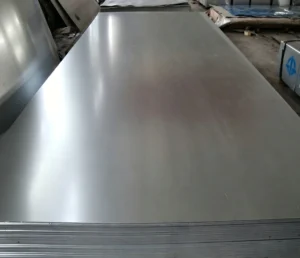
















For a standard building project, choose thickness from the finished profile, support spacing and forming requirements—not from price alone.
Choose zinc or aluminium-zinc coating from the exposure, cut-edge risk and expected service period.
For roofing and cladding with broad intact surfaces, compare PPGI and PPGL on the same base-metal thickness and coating specification. If field cutting, tight bends or copper contact are present, mark those conditions before asking for a quote. Bomis Steel can compare the requested basis, but the final grade, coating mass, and application must be confirmed against the project drawing and applicable standard.
Takeaway: Five Decisions to Make Before You Request a Quote
- Uso recomendado: Start with the roof or wall profile, support spacing, design load, and whether the sheet is exposed as a broad intact surface.
- Choose thickness by performance: Use the drawing and forming route to decide the base-metal thickness; do not treat a thicker coating as a substitute for structural thickness.
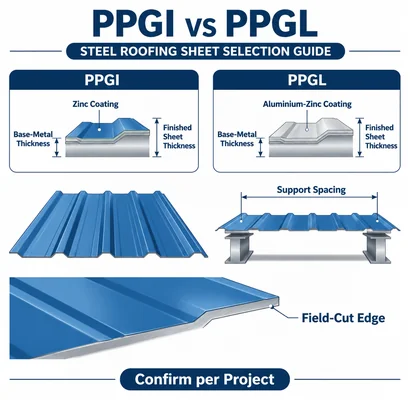
- Coating boundary: PPGI uses a zinc-coated substrate; PPGL uses an aluminium-zinc coated substrate. Compare the coating designation, not only the product name.
- Specify fully: State the standard, steel grade, base-metal thickness or finished-sheet thickness basis, coating mass, width, profile, paint system, colour, tolerance, and test documents.
- Verifica antes de pagar: Match the coil or sheet identification to the MTC, measured coating result, dimensions, paint information, packaging, and inspection record.
This article gives a project-level selection route rather than a universal thickness or coating number. The correct answer depends on the drawing, exposure and the measurement basis written into the quotation. Keep uncertain fields open until the supplier and project team confirm them.
What Should You Decide First: Thickness, Coating, or Project Exposure?
The first decision is not “PPGI or PPGL?”
It is the job the sheet must perform. A roof panel spanning between supports, a wall panel fixed to closely spaced rails and a flashings component do not carry the same load or undergo the same forming strain. Write down the panel profile, effective cover width or maintenance load where relevant, and the way the sheet will be lifted and installed. Those inputs tell the supplier what the steel has to do.
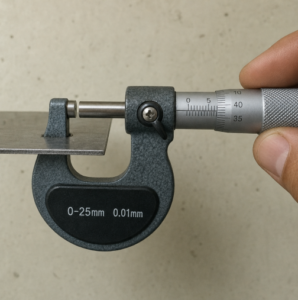
Next, separate the base-metal thickness from the finished coated-sheet thickness.
A drawing that says “0.50 mm” may mean base metal thickness, total coated thickness, or a nominal value that still needs clarification. Those are not interchangeable measurements. Ask the supplier to state the measurement basis and tolerance on the quotation. The same rule applies when two suppliers quote the same number: a fair comparison requires the same thickness basis and paint system.
Then describe the exposure.
Inland storage, humid industrial air and buildings with copper flashings create different risks. A broad intact panel face and a cut edge do not receive the same protection from a coating. The answer changes again when the sheet is deeply formed, repeatedly drilled, or cut on site. Put those conditions into the RFQ instead of expecting a product name to carry them.
How Is PPGI Different From PPGL at the Coating Level?
PPGI means prepainted galvanized steel. The steel substrate receives a zinc coating before the organic paint system is applied.
PPGL means prepainted galvalume or aluminium-zinc coated steel. The substrate receives an aluminium-zinc alloy coating before primer and topcoat. In both products, the visible colour comes from the paint system; the metallic coating below it contributes to corrosion behaviour at the panel face, cut edges, scratches, and formed areas.
A zinc coating mainly relies on sacrificial protection around exposed steel. An aluminium-zinc coating combines a zinc component with an aluminium-rich barrier effect across an intact surface. That difference matters when the panel face is the dominant exposure. It does not mean PPGL automatically wins every project. Frequent field cuts, exposed edges, tight bends, or uncertain edge treatment require a separate review. A coating that performs well on an intact sheet face may need different handling at a cut edge.
Do not compare “Z275” with “AZ150” as if the numbers were the same unit. Z designations normally identify the total zinc coating mass on both sides under the applicable standard.
AZ or AZM designations identify the total aluminium-zinc coating mass on both sides under the applicable standard. The alloy and the measurement basis are different. The quotation should state the standard and the coating designation together, for example, “coating to [standard and edition to confirm], designation [Z or AZM value], coating mass reported per the applicable test method.”
The paint layer is a separate decision. PE, SMP, HDP, and PVDF are not interchangeable labels for every application. The supplier should state the paint system, topcoat and backcoat information where relevant, nominal coating thickness if specified, colour reference, gloss or surface requirement if relevant, and whether a protective film is required. For a high-UV or coastal project, ask for a system recommendation tied to the exposure rather than selecting a paint name in isolation. See the related PPGI & PPGL roof sheet range for the product context, then confirm the actual project specification before ordering.
How Should You Choose Sheet Thickness for Roofing and Cladding?
Thickness is a performance input. Start with the profile geometry and the span between supports. A deeper rib or standing seam profile can change stiffness, but it does not remove the need to check the design load and fixing arrangement. Ask the roll former or structural designer to confirm the allowable span and load table for the exact profile, steel grade, thickness, and fastening system. If that information is not available, the supplier should not promise a span from thickness alone.
Forming is the second check. A sheet that will be roll-formed into a roofing profile may need enough ductility for the bends, lock, ribs, and end details. A sheet that will be cut into flashing or pressed into a complex shape may have a different forming requirement. Tight bends can damage the metallic coating or paint film if the grade, forming radius, or process is unsuitable. Put the forming method and minimum bend requirement in the RFQ. Do not use “0.60 mm” as a complete forming specification.
Handling and installation also affect the practical choice. Thin sheets can be easier to handle, but they may be more sensitive to oil canning, local denting, foot traffic, or rough unloading. Heavier sheets add material cost and may change container loading, lifting, and profile tooling. The right comparison is not simply thin versus thick. Compare the same support spacing, profile, steel grade, thickness basis, coating, paint system, and installation method.
For an early quotation, you can ask for two thickness options on the same basis. This gives the project team a usable cost comparison without pretending the final thickness has already been engineered. The quotation should clearly mark any value as “for budget comparison only” until the drawing, load condition, profile, and tolerance are confirmed.
Which Zinc or Aluminium-Zinc Coating Should You Specify?
Choose the coating from the exposure and the way the sheet will be used. A low-exposure interior wall is not the same as a roof that remains wet, a coastal façade exposed to salt spray, or an agricultural building with ammonia and condensation. The coating designation should be selected with the project environment, service period, cut-edge treatment, fasteners, flashings, and maintenance plan in view.
For PPGI, the RFQ may use a zinc designation such as Z value under the applicable standard. For PPGL, the RFQ may use an AZ or AZM designation. The exact value must come from the drawing, specification, or supplier recommendation supported by the site exposure. If the drawing only says “prepainted galvanized sheet” or “PPGL roofing,” ask for the missing coating mass, paint system, thickness basis, and standard edition before comparing offers.
Do not treat the coating mass as a direct service-life guarantee. Service life depends on humidity, pollutants, salt, wet-dry cycles, temperature, cut edges, fasteners, drainage, dirt retention, installation damage, and maintenance. A higher designation may be appropriate, but the supplier still needs to confirm whether the full system is suitable for the exposure. Direct marine exposure deserves a written system review. A general “coastal” label is not enough if the site receives direct salt spray.
Where the project includes frequent cuts or exposed drilled holes, ask how edges will be treated and whether the recommendation changes from PPGL to PPGI. Zinc can provide sacrificial protection near exposed steel, while an aluminium-zinc coating may rely more heavily on the condition of the edge and the surrounding system. This is a design and installation question, not a slogan about which product is always better.
What Conditions Can Reverse the Initial Material Recommendation?
Field cuts, holes, and exposed edges
Mark every field-cut opening, notch, drilled hole, and exposed end on the drawing. Ask for the edge treatment, touch-up requirement, minimum distance from the edge, and inspection method. If cut edges are numerous or difficult to protect, make edge behaviour a primary comparison item rather than a note at the end of the order.
Tight bends and roll-forming strain
Provide the forming route, minimum bend radius, profile drawing, and production speed where known. Ask the supplier to confirm the recommended steel grade and whether the metallic coating and paint film are compatible with the forming operation. A coating decision cannot compensate for a grade or radius that is wrong for the forming line.
Salt spray, chemical fumes, and agricultural exposure
State the actual exposure: distance from the coast, direct salt spray or industrial fumes.
Ask for a written suitability review covering the sheet, fasteners and maintenance. “Outdoor use” is too broad to support a coating decision.
Copper flashings and dissimilar metals
Circle every location where the sheet may touch copper or another dissimilar metal. Confirm a compatible interface or isolation detail. The panel coating is only one part of the node. A suitable sheet can still experience galvanic corrosion if the surrounding detail creates an incompatible metal contact in a wet environment.
What Should the Specification and RFQ Line Include?
A usable RFQ makes each supplier quote the same product. Include the governing standard and edition, inspection requirement, and required documents.
| Field | What to state or confirm | Why it matters |
|---|---|---|
| Product route | PPGI zinc-coated substrate or PPGL aluminium-zinc coated substrate | Sets the metallic coating system being compared |
| Standard and grade | Standard, edition, steel grade [to confirm] | Connects chemistry and mechanical requirements to the order |
| Thickness basis | Base metal or finished coated sheet; value and tolerance | Prevents false price and performance comparisons |
| Coating designation | Z or AZ/AZM value under the selected standard | Defines the coating requirement and reporting basis |
| Profile and width | Profile drawing, effective width, overall width, length | Links the sheet to span, overlap, and installation |
| Paint system | Topcoat, backcoat, colour reference, gloss, film if required | Controls appearance, forming and exposure expectations |
| Documents | Coil or batch identification, MTC, inspection and packing records | Allows the delivered material to be traced and checked |
If the project drawing has not confirmed every field, leave the uncertain items visible. Do not silently fill them with a supplier default. A practical first RFQ can read:
Please quote PPGI and PPGL sheets for the attached roofing/cladding profile: standard and edition [to confirm], steel grade [to confirm], thickness [value] mm measured on [base metal or finished coated sheet: please confirm], coating designation [Z or AZ/AZM value: please confirm], effective width [to confirm], colour [RAL to confirm], paint system [to confirm], tolerance [to confirm], coil or sheet quantity [to confirm], and coil-specific MTC with measured coating and thickness results.
If the drawing already gives the thickness but not its basis, preserve the value and ask the supplier to clarify it rather than deleting it: Thickness: 0.60 mm; measurement basis [base metal or finished coated sheet: please confirm], with applicable tolerance and unit.
How Do You Verify Thickness and Coating Before Payment and Shipment?
Use the order as the checklist. Before payment, match the quotation, pro forma invoice, drawing, and technical confirmation. The supplier must support the product name with measurable requirements. Check the standard, grade, thickness basis, coating designation, width, colour, paint system, quantity, tolerance, and document requirements line by line.
- Before payment: confirm the supplier’s technical confirmation and ensure the exact product route—PPGI or PPGL—appears on the document.
- Before production or slitting: approve the profile, effective width, thickness basis, colour reference, coating designation, and tolerance.
- Before shipment: match coil or batch numbers to the MTC, measured thickness, coating result, surface condition, dimensions, and packing record.
- For disputed coating results: agree the test method in advance. XRF can provide a rapid reading when properly calibrated; a mass-based method may be used where the contract requires it. The report must identify the tested material.
- For ocean shipping: check dry steel, intact moisture barriers, protected edges and coil eyes, suitable desiccant, and packaging appropriate for the route.
Third-party inspection can be added when the order, destination, or project risk justifies it. The inspection scope should name the records to review and the acceptance criteria. A generic “inspection passed” statement is weaker than a report linked to coil numbers and measured results.
How Can Bomis Steel Help You Compare the Two Options?
Bomis Steel can prepare a like-for-like comparison when you provide the profile drawing, project location, exposure conditions, required colour, estimated quantity, delivery destination, and the thickness information already shown on the drawing. We can separate confirmed requirements from items still open, then quote PPGI and PPGL on the same thickness basis where the project allows a fair comparison. Send the roof or wall drawing, site exposure, and specified thickness basis so we can identify the fields that need confirmation before the order is placed.
Conclusion: Choose the Basis Before You Choose the Number
The right PPGI or PPGL sheet is not defined by thickness or coating mass alone. First define the profile, support spacing, forming route, exposure, cut-edge risk, and measurement basis. Then compare PPGI and PPGL using the same standard, steel grade, thickness basis, coating designation, paint system, width, tolerance, and documents. If the site has salt spray, chemical exposure, copper contact, or dense field cutting, ask for a system review instead of relying on a generic product label. A complete RFQ gives every supplier the same question and gives the buyer a result that can be checked before payment and shipment.
FAQ: PPGI/PPGL Thickness and Coating Selection
Should I choose a thicker sheet or a higher coating mass?
Choose thickness for structural and forming requirements. Choose coating mass for the specified exposure. Neither replaces the other; confirm both against the drawing, environment, and standard.
Is 0.60 mm always base-metal thickness?
No. It may refer to base metal, finished sheet, or a nominal value. Keep the value in the RFQ and ask for the basis, tolerance, unit, and test result.
Is PPGL always better than PPGI?
No. PPGL may suit broad intact surfaces, while PPGI deserves comparison when cut edges, holes, forming, or edge protection dominate the risk.
What should I write if the coating designation is missing?
Write “coating designation [Z or AZ/AZM value: please confirm]” and request the standard, edition, coating basis, and coil-specific test result before comparing prices.
Can I compare base thickness with finished thickness?
Not fairly. Ask both suppliers to quote on the same thickness basis and state the tolerance. Keep the original drawing value visible during clarification.
What information should I send with my first enquiry?
Send the profile drawing, location, exposure, support spacing, thickness and basis if known, coating preference, colour, quantity, destination, and required documents.