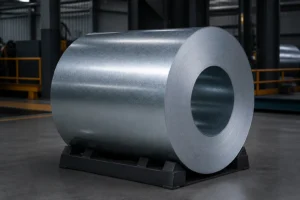
AI Takeaway
A CGCC RAL 5020 roofing coil is not defined by colour alone. The buyer must confirm the metallic substrate, steel grade, paint family, coating schedule, dimensions and forming route. PPGI uses galvanized steel; PPGL uses an aluminium-zinc coated steel substrate. Both can carry a RAL 5020 colour reference, but they are not interchangeable materials.
For a usable quotation, state the governing standard, base-metal thickness, width, tolerances, coil ID, coil OD, target coil weight, quantity, surface finish, exposed face, roofing profile and packing requirements. Treat the reference page’s listed ranges as a starting point only. Final specifications, paint-film schedule, coating mass, documents and order quantity must be confirmed per order.
A reliable specification also names the receiving line and end use. Roofing profile, bend radius, storage conditions and handling limits can change the practical requirement. Keep PPGI and PPGL on separate material lines when a project uses both. Confirm open items in writing before production, rather than allowing a colour code or a long product title to stand in for the full technical schedule.
What does CGCC RAL 5020 PPGI or PPGL mean?
The phrase combines several different decisions that should remain separate in a purchase order.
CGCC identifies the requested steel grade. It does not, by itself, define the metallic coating, paint system, colour, thickness or end-use profile. The governing standard and mechanical requirements still need confirmation.
RAL 5020 is a colour reference. It helps the buyer and supplier discuss the intended blue tone, but it does not define primer, topcoat, back coat, gloss, paint thickness or outdoor-performance requirements. An approved colour sample may still be required when colour matching matters.
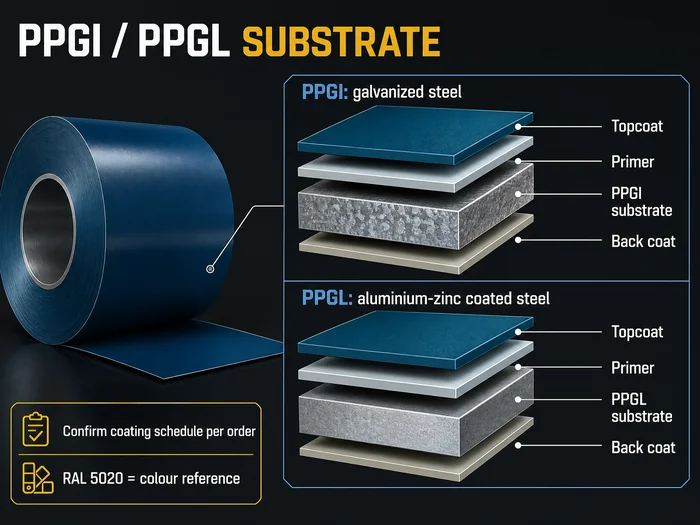
PPGI means prepainted galvanized steel. The steel substrate carries a zinc coating before the paint system is applied.
PPGL means prepainted aluminium-zinc coated steel. The metallic substrate is different from PPGI even when the colour, coil dimensions and paint family are similar.
The buyer should therefore write the enquiry as a series of fields rather than one long product name. That prevents a supplier from assuming the substrate or coating schedule from the colour code alone.
How should a buyer choose between PPGI and PPGL?
Start with the project specification, not the colour. PPGI and PPGL answer different substrate requirements.
| Decision point | PPGI | PPGL |
|---|---|---|
| Metallic substrate | Galvanized steel | Aluminium-zinc coated steel |
| Paint colour | RAL reference or approved sample | RAL reference or approved sample |
| Typical question | What zinc coating and grade are required? | What aluminium-zinc coating and grade are required? |
| Forming review | Confirm profile, bend radius and surface protection | Confirm profile, bend radius and surface protection |
| Order control | Separate substrate, paint and dimensions | Separate substrate, paint and dimensions |
This table is a buying framework, not a substitute for the governing standard. A roofing project may accept one substrate and exclude the other. Another project may permit both but require different coating masses, paint systems or inspection documents.
At Bomis, the quotation should state “PPGI” or “PPGL” explicitly. Avoid using “prepainted steel coil” without naming the substrate. That short phrase can hide a material mismatch.
Why does RAL 5020 need a separate colour confirmation?
A RAL code gives the order a shared colour reference, but the finished appearance also depends on the paint system, gloss, surface texture, production line and viewing conditions. A buyer specifying RAL 5020 should confirm whether the project needs a standard RAL match, an approved physical sample or a customer colour standard.
Gloss is another separate field. A smooth high-gloss finish reflects light differently from a matt or textured surface. If roof sheets will be viewed from the ground, the visual requirement may differ from a façade project where panels are inspected at close range.
The visible face also matters. A coil can have a specified top face, back coat and handling direction. A roofing profile may expose one face after forming while the other remains hidden. State the exposed face and any requirement for protective film, surface treatment or temporary protection.
Do not promise colour retention or service life from RAL 5020 alone. Those requirements depend on the paint family, film schedule, exposure, maintenance and the project’s written specification.
Which paint system should be specified for roofing?
The paint system should follow the site environment and forming route. PE, HDP, SMP and PVDF can represent different performance and cost choices, but the suitable option depends on the buyer’s specification.
For a standard inland roofing project, the buyer may focus on colour, forming behaviour, surface appearance and basic weather exposure. A project with stronger sunlight, demanding appearance retention or a formal coating specification may need a different paint family or film schedule. The final choice must be confirmed rather than inferred from the phrase “RAL 5020”.
A clear enquiry identifies:
- Paint family: PE, HDP, SMP, PVDF or another approved system.
- Primer and topcoat requirements.
- Back-coat requirement and colour.
- Nominal paint-film thickness and tolerance, if specified.
- Gloss or surface-finish requirement.
- Test, inspection or documentation requirements.
The paint schedule should also match the forming process. Tight bends, repeated roll forming, slitting and manual handling can affect the visible surface. Send the roofing profile and bend geometry before final approval.
Which dimensions belong in the quotation?
A product title may mention roofing material, but the production line needs a complete dimensional schedule. At minimum, state the base-metal thickness, full width, tolerance, coil ID, coil OD, target coil weight and total quantity.
The reference product page shows example ranges for thickness, width, coil ID and coil weight. Those figures should be treated as reference information, not as a confirmed Bomis offer. Bomis should confirm the available range against the requested grade, substrate, paint line and order plan.
The buyer should also state whether the order needs:
- Parent coils for the buyer’s own slitting or roll forming.
- Slit coils with defined slit widths and edge condition.
- Cut-to-length sheets for a downstream roofing line.
- A specified coil weight to suit an uncoiler or lifting plan.
- A specified outer diameter for loading and handling.
Width tolerance and edge condition affect the roofing profile. A small mismatch can create waste or require a line adjustment. Put the tolerance in the enquiry instead of relying on a general catalogue range.
How should the coil be reviewed for roofing production?
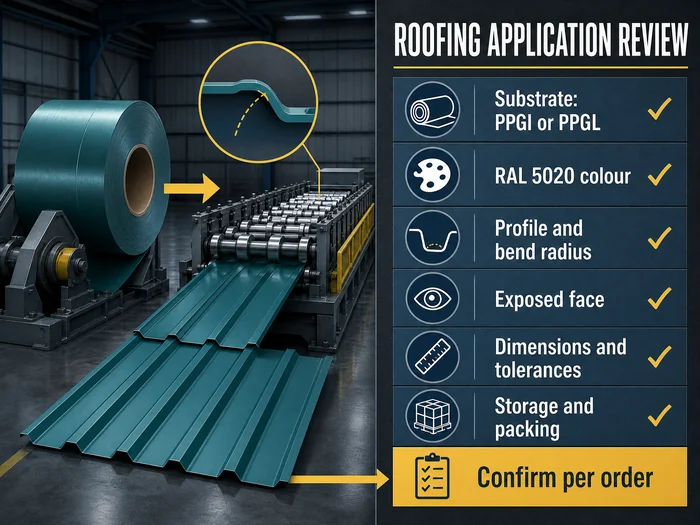
Roofing buyers should send the profile drawing before selecting the final coil specification. The drawing shows the finished section, bend sequence, effective cover width, overlap and cut length. The supplier can then review grade, thickness, paint system and surface protection together.
The visible face should be identified. The top surface may need tighter control for colour, gloss and scratches, while the reverse side may follow a different back-coat requirement. The buyer should explain whether protective film is needed, how long the coil will be stored and whether the finished sheets will be exposed before installation.
Roll forming is not only a thickness question. Grade, coating, paint flexibility, bend radius, line speed, tooling condition and handling all influence the result. A supplier should not confirm suitability from the product title alone.
When the project uses both PPGI and PPGL in different areas, keep the two material schedules separate. This avoids mixing galvanized and aluminium-zinc substrate requirements during production or installation.
What should be included in the order confirmation?
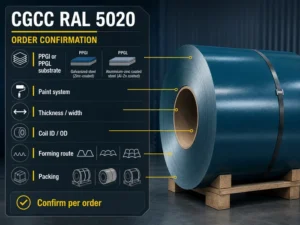
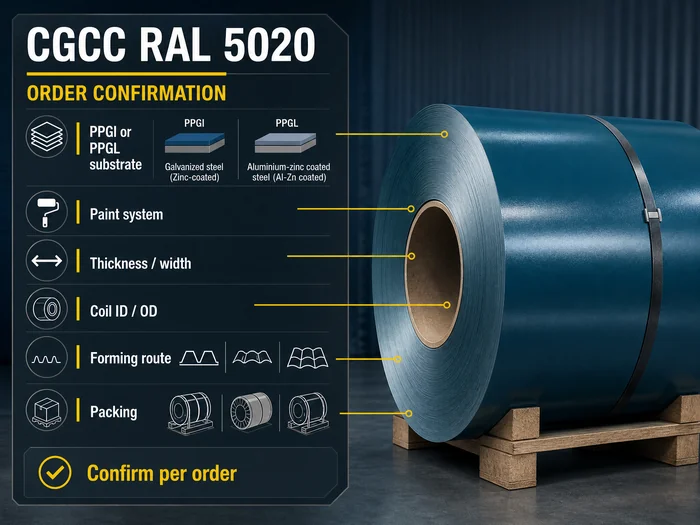
A practical order confirmation should gather the commercial and technical fields in one place. The buyer can use the following sequence:
- Product: prepainted steel coil for roofing.
- Grade: CGCC or the governing grade designation.
- Substrate: PPGI galvanized steel or PPGL aluminium-zinc coated steel.
- Colour: RAL 5020 or approved sample reference.
- Paint: paint family, primer, topcoat, back coat, gloss and film schedule.
- Dimensions: thickness, width, tolerances, coil ID, coil OD and coil weight.
- Processing: parent coil, slit coil or cut-to-length sheet.
- Quantity: total tonnes, coil count or container plan.
- Packing: export packing, edge protection, moisture protection and shipping marks.
- Documents: inspection and material documents required by the project.
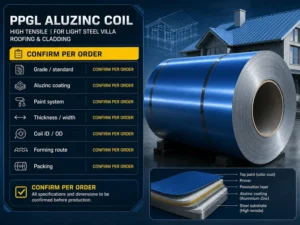
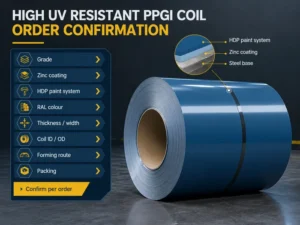
The product page should make open items visible. “Confirm per order” is more useful than inserting an unverified number that may not suit the buyer’s line.
For shipment planning, review the <a href="/es/”https://www.bomissteel.com/steel-coil-export-packing/”/">steel coil export packing guide</a>. For material comparison, review the <a href="/es/%e2%80%9dhttps%3a//www.bomissteel.com/colecciones/ppgi-coil/%e2%80%9d/">PPGI Coil range</a> and the <a href="/es/%e2%80%9dhttps%3a//www.bomissteel.com/colecciones/bobina-de-acero-galvanizado/%e2%80%9d/">Galvanized Steel Coil range</a>.
How does PPGI or PPGL compare with unpainted coil?
Prepainted coil moves part of the finishing decision upstream. The buyer receives a coil with a defined visible colour and paint system, then forms it into roofing or panel products. That can simplify downstream painting, but it also makes the initial specification more important.
Unpainted galvanized or aluminium-zinc coated coil may leave more finishing work for the fabricator. Prepainted coil reduces that step, but the buyer must control colour, film schedule, exposed face, forming route and storage. Neither material is automatically right for every project.
The comparison should consider the finished product, not only the coil price. Include forming, painting, handling, storage, waste, inspection and installation requirements in the project decision.
How should PPGI and PPGL coils be packed and stored?
Packing should match the route from the supplier to the roll-forming or installation site. Confirm coil orientation, strapping, wrapping, edge protection, moisture protection, lifting points, shipping marks and container-loading limits.
The buyer should also state the expected storage conditions. Prepainted surfaces need protection from contamination, standing water, impact and unnecessary handling. The storage plan should prevent the coil from becoming a source of surface defects before forming.
Coil weight and outer diameter must suit the buyer’s lifting equipment and uncoiler. A technically correct coil can still create a production problem if the handling plan is not confirmed before shipment.
Preguntas frecuentes
Is CGCC RAL 5020 a complete product specification?
No. Confirm PPGI or PPGL substrate, paint system, dimensions, forming route, packing and documents.
Can the same RAL 5020 colour be used for PPGI and PPGL?
The colour reference can be used for either substrate, but confirm the paint schedule and substrate separately.
Is RAL 5020 a paint brand or coating grade?
No. RAL 5020 is a colour reference. It does not define primer, topcoat, film thickness or gloss.
What does CGCC tell the buyer?
CGCC identifies the requested steel grade. Write the governing standard and mechanical requirements into the order.
What is the difference between PPGI and PPGL?
PPGI uses galvanized steel; PPGL uses aluminium-zinc coated steel. The substrate specification is different.
Can this coil be used for roofing sheets?
Review it for roofing when grade, substrate, thickness, paint system, profile and bend requirements match the project.
Should the buyer specify PE, HDP, SMP or PVDF?
Compare exposure, appearance, forming, maintenance and the project specification before selecting the paint family.
What should be confirmed before shipment?
Confirm dimensions, weight, packing, protection, shipping marks, documents and receiving-line handling limits.
Conclusión
A reliable CGCC RAL 5020 roofing enquiry separates the colour from the material system. Name the substrate as PPGI or PPGL, identify CGCC and the governing standard, define the paint schedule, provide the roofing profile and confirm dimensions, packing and documents per order. This gives the supplier enough information to quote the right coil instead of guessing from a long product title.