A Field Interview on Deposit Traps, Forged Packing Lists, and How to Protect Your Capital
- Expert Guest: Sofia (Senior International Trade Director, Bomis Steel)
- Interviewer: Mark (Global Commodities & Procurement Analyst)
- Background: Recently, Sofia accompanied an overseas building materials distributor to directly confront a supplier claiming to be a “major state-of-the-art Chinese steel mill.” The client had paid a 50% cash deposit back in April, promised a 20-to-25-day delivery window. By November—seven full months later—not a single coil had shipped. When the buyer arrived on site demanding an explanation, the supplier issued a hostile ultimatum: “Pay the remaining 50% balance via T/T right now, or you get nothing.”
Part 1: The On-Site Confrontation — “100% Upfront or No Cargo”
Mark: Sofia, welcome. You recently walked straight into an explosive face-to-face confrontation on behalf of an overseas buyer. Could you walk us through what actually happened?
Sofia: Thanks, Mark. This case is a sobering case study for anyone importing steel coils internationally. My client is an established building materials distributor based in the Middle East. Back in April, he found an online supplier marketing themselves as a large-scale galvanized and prepainted steel (PPGI) mill in North China. They signed a contract requiring a 50% deposit with an agreed lead time of 20 to 25 days.
By November—seven months later—nothing had shipped. Every inquiry was met with evasive excuses: raw material shortages, environmental inspections, port congestion.
The client flew into China and asked me to accompany him as an industry specialist to inspect the facility. When we arrived at the registered address, there was no mill. No galvanizing lines, no annealing furnaces, no overhead cranes. It was simply a rented trading desk inside a generic commercial park.
Worse still, the manager sat across from us and bluntly stated: “If you want your steel released, you must wire the remaining 50% balance via T/T today. No balance, no cargo.”
Mark: After holding a 50% deposit for seven months, they demanded 100% full prepayment before releasing anything? How did the buyer react?
Sofia: The client was shaking with frustration. He turned to me and said, “Sofia, they’ve held half my money hostage for over half a year. If I wire the remaining 50% today, what guarantees they won’t simply vanish or dump off-spec scrap on me? I’ll lose my entire business and all legal leverage.”
His instinct was spot-on. When a supplier breaches contract terms for seven months and then insists on 100% T/T cash remittance before loading or issuing a Bill of Lading, you are no longer dealing with a manufacturing delay—you are facing an advance-fee trap or a broker on the brink of financial insolvency.
Part 2: Dissecting the Paper Trail — Forgeries and Dead Giveaways
Mark: As an experienced steel exporter, you reviewed the documents this vendor provided—the quotation sheets, proforma invoices, and so-called “packing lists.” What immediately raised red flags?
Sofia: There were two blatant red flags that exposed them immediately.
1. The Mathematical Absurdity of the “Perfect 100.00 MT” Total
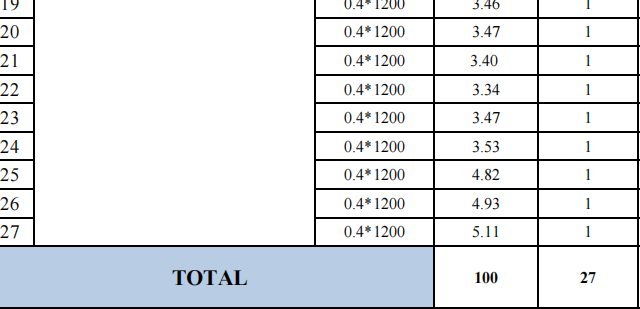
Sofia: To prove that the cargo was “ready in warehouse,” the vendor produced an inventory summary listing 27 individual coils. Each row displayed arbitrary two-decimal weights: 3.46 MT, 3.47 MT, 4.82 MT, 5.11 MT, and so forth.
Then you look at the bottom line: 27 random decimal numbers somehow magically summed up to an exact integer: 100.00 MT.
Mark: Is that physically possible on a real coil packing list?
Sofia: It is an absolute physical impossibility in modern metallurgy. Steel coils are rolled from continuous hot-rolled master bands, pickled, cold-reduced, galvanized, slit, and weighed on certified digital scale beds. Variations in crown, thickness tolerance, and cut length mean actual net weights always yield irregular decimals—such as 99.845 MT or 100.260 MT.
A list of 27 random decimal coil weights that adds up to a clean, round 100 is proof of a fabricated spreadsheet typed out by a clerk trying to match a buyer’s purchase order. Furthermore, legitimate mill tally sheets require a unique Coil ID number, Heat/Batch number, and gross/net tare breakdown for each item. Their sheet left all of that blank.
2. Sloppy Proformas and Unilateral Contract Terms
Sofia: Look closely at their commercial proforma. The payment clause was amended to
Payment: T/T (100% full payment). Furthermore, the document was riddled with careless typos, including "Port of LoaLoading".Tier-1 mills operate standardized ERP systems, legal compliance teams, and disciplined documentation. Slipshod contracts and cut-and-paste commercial terms are typical of fly-by-night brokers with zero quality control infrastructure.
Part 3: The Trap — How Rational Importers Get Caught
Mark: These indicators are clear when laid out side by side. Why do experienced distributors still get lured into these traps?
Sofia: Unscrupulous brokers exploit two psychological vulnerabilities:
- The “Below-Market” Price Hook: Shady intermediaries offer prices $30 to $50 per metric ton below the baseline cost of raw hot-rolled substrate and zinc ingot. Buyers think they’ve negotiated an incredible bargain. In reality, steel production carries non-negotiable physical commodity costs. If a quote is below raw material cost, the vendor plans to short-change the zinc coating, supply non-prime secondary steel, or capture the deposit.
- The “Virtual Mill” Deception: Intermediaries download drone footage of modern production complexes, upload forged ISO certificates, and claim to operate “three advanced continuous galvanizing lines.” Foreign buyers who skip on-site verification take those digital storefronts at face value.
Once that 50% deposit lands in the broker’s private account, the dynamic reverses. The deposit is often diverted to cover other operational deficits or speculative bets. If raw material prices spike, the broker stalls indefinitely—eventually demanding 100% full payment upfront as a final leverage play.
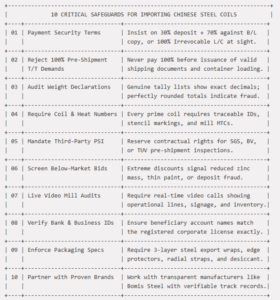
Part 4: Sofia’s Checklist — 10 Things to Know Before Importing Steel Coils
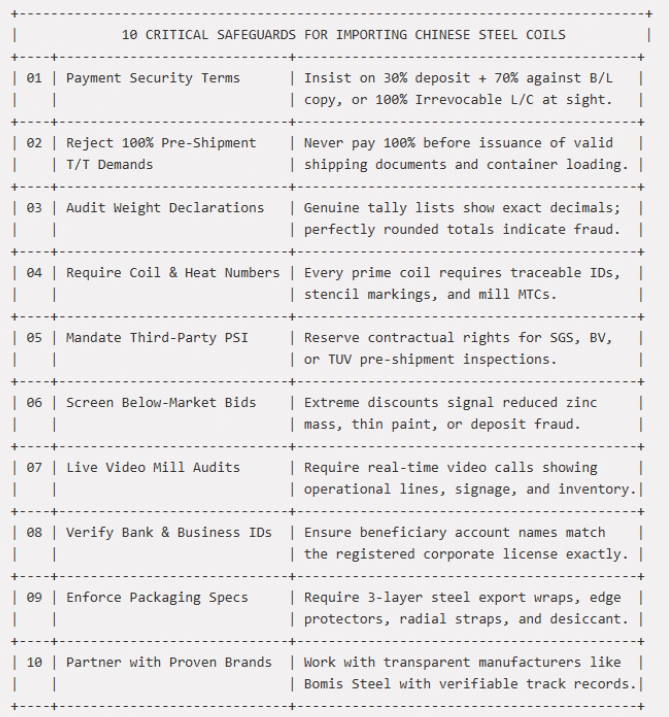
Mark: Thanks to your intervention, your client refused the 100% remittance demand and retained his remaining capital to pursue legal recovery. For overseas buyers currently sourcing steel coils from China, what are your cardinal rules?
Summary Takeaway
Mark: This is a powerful, practical breakdown. Sofia, what is your final piece of advice for international procurement managers?
Sofia: International steel procurement should never feel like a gamble. Quality manufacturers welcome independent inspections, provide transparent mill documentation, and protect buyers with balanced commercial terms. When a supplier refuses basic transparency or demands full payment upfront on a stalled order, walk away and protect your business.