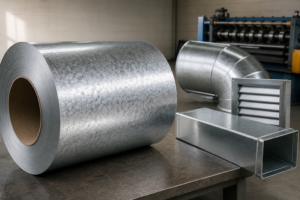

















I. Visual Inspection: Pre-Analysis Quality Level Based on Appearance Data
The good steel coils are visible and show a definite “regularity”, where worse-quality ones are found to have a lot of imperfections that are easy to detect when the product is displayed.
Surface Color and Luster
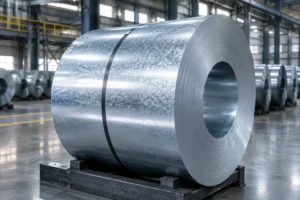
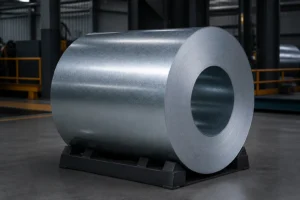
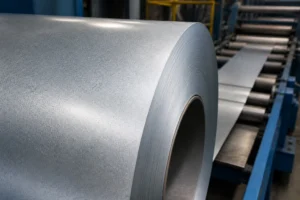
The surface of high-quality galvanized steel coils is uniformly silver-gray or bluish-white, with a consistent color and no considerable variation in brightness. For hot-dip galvanized or electro-galvanized products, the general luster is quite soft, which consists of the absence of bright spots or dull spots.
Good products have a stable zinc solution, uniform plating deposition, and a complete surface oxide film. Inferior galvanized steel coils generally show uneven color; some areas show the base metal color (due to a thin zinc layer), while other areas are dull and rough secondary to the accumulation of zinc slag. If “white rust” appears (the white powdery zinc salts on the surface), it is primarily due to the moisture retained during storage and transport, which oxidizes this zinc layer, making these products extremely less resistant to corrosion.
Furthermore, black streaks or spots appearing on the surface are often due to insufficient oxidation of the substrate of the product during fabrication or improper control of the furnace atmosphere, resulting in carbon and scale residue in the substrate that are indicative of inferior products.
Surface Flatness and Defects
High-quality galvanized steel coils have a flat and smooth surface without significant bumps, wrinkles, scratches, and indentations, and the edges are neat and without warping.
Hot-dip galvanized products have a uniform size and uniform distribution of zinc spangles (patterns formed during the solidification of the zinc layer); no abnormal protrusions or depressions are present. This is due to stable zinc bath temperature, consistent air knife pressure, and appropriate substrate pre-treatment during production.
The surface of very poor-quality products generally appears to have multiple complications: the most well-known defects include localized rough surfaces as well as the accumulation of zinc slag causing inclusions and lumpiness. This impurity gives the surface roughness and can even, in the most serious conditions, lead to distortion of edges after coiling. The product may in effect have bubbles or pinholes, which occurs due to less gas released during galvanizing, greatly decreasing the density and corrosion resistance of the zinc layer. The presence of hot wrinkles—localized unevenness and thinning or elongation of the plate surface—is mainly due to high plate temperature, low line speed, and uneven material thickness during production, and is a structural defect. These are the reasons that affect the preparation and production of future products which may be used.
Edge and Cut Condition
The edge of high-quality galvanized steel coils is neatly cut with no burrs or flashing, and the zinc layer on both sides of the edge interfaces well with the zinc layer on the plate surface, where no obvious exposed base material or accumulation of zinc layers occurs. And yet at both the head and tail of the coil, the zinc layer is evenly spread, without localized peeling or corrosion.
Low-quality products’ edges often have burrs and uneven notches, and the edge zinc layer becomes open to “exposure of the base material.” This is because the thickness of the edge layer of the coatings can be poor in the manufacturing process; indeed, there may be a peeling of the layers of zinc on the edges when zinc powder comes off with a light rub of the coating, representing an early indicator of low application of the coating.
| Inspection Area | High-Quality Indicators | Inferior-Quality Indicators |
|---|---|---|
| Color & Luster | Uniform silver-gray/bluish-white, soft and consistent luster. | Uneven color, visible base metal, white rust, or black carbon spots. |
| Flatness & Surface | Smooth, flat, uniform zinc spangles without bumps. | Zinc slag lumps, bubbles, pinholes, or hot wrinkles. |
| Edges & Cuts | Neatly cut, no burrs, even coating with no exposed base metal. | Burrs, uneven notches, exposed base material, or peeling zinc. |
II. Simple Tests of Quality Verification, Fundamental
If visual assessment is unable to prove the quality, some straightforward tests can be performed for further verification, such as using performance indicators that are closer, such as the adhesion and uniformity of the zinc layer. These tests are conducted without professional equipment.
Test: Adhesion of the Zinc Layer
The strength of the bond between the zinc layer and substrate is one of the central characteristics of high-quality galvanized steel coils. Inferior products have poor adherence and are known to exhibit a high rate of zinc layer peeling and separation during the treatment/use process.
One such technique is the ‘bending test’, which is the measurement of the small sample and bending it on a rigid wire in a 2D axis with a manual or simple tool (consistent with the plate thickness). As a result, cracks, peeling, or blistering will NOT occur at the zinc layer of a product of high quality and should not be observed. If the zinc layer peels over a large area after bending, or if the black base material is exposed, then it is a poor-quality product.
Next, the “Tape test” (or cross-hatch test): We open up the sample surface, use a ruler, and cut squares into the coating to form a grid using a utility knife. We then apply strong adhesive tape tightly over the grid and rapidly pull it off. If flakes of the zinc layer come off with the tape and expose the base metal beneath, the adhesion is fundamentally compromised, indicating a substandard product.