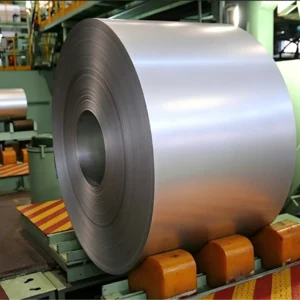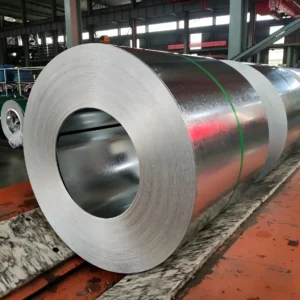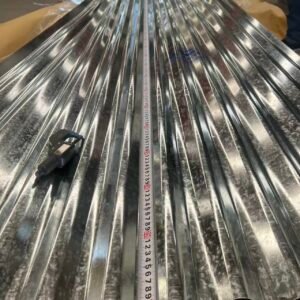
If you’re sourcing materials for industrial, commercial, or even residential builds, Galvalume roofing sheets are a top-tier choice. We coat these steel sheets with a specialized aluminum-zinc alloy, giving them incredible resistance to corrosion. The magic is in the mix: specifically, a coating that’s 55% aluminum and 43.4% zinc. This exact ratio pairs the tough physical barrier of aluminum with the sacrificial, galvanic protection of zinc. It’s exactly why so many wholesale buyers rely on it for long-term performance, no matter what climate they’re dealing with.
1. Unmatched Corrosion Resistance: You can expect 2 to 4 times the corrosion protection of a standard galvanized sheet. This massive boost in durability is a lifesaver for projects exposed to harsh coastal air, high humidity, or heavy industrial pollution where standard materials just break down too fast. This extended durability is particularly valuable for projects in coastal, high-humidity, or industrial environments where atmospheric exposure accelerates material degradation.
2. A Coating That “Heals” Itself: Thanks to the high aluminum content, minor scratches and cut edges essentially self-repair. As soon as the exposed aluminum hits the air, it oxidizes to form a protective seal. This stops red rust in its tracks before it can even spread. When exposed to the atmosphere, the aluminum component forms a protective oxide layer that seals exposed steel edges, reducing the risk of red rust propagation.
3. Keeps the Load Light: Galvalume sheets are incredibly lightweight, usually sitting between 2.4 and 15.7 kg/m² depending on how thick you need them. Compared to heavy clay or concrete tiles, this takes a massive load off your building’s structural requirements, cuts down on shipping headaches, and makes on-site installation a breeze. This characteristic simplifies logistics, reduces structural load requirements, and speeds up on-site installation.
4. More Bang for Your Buck (Greater Coverage): Because the aluminum-zinc coating is less dense than pure zinc, you actually get about 3% more surface area per ton compared to galvanized steel. When you’re buying wholesale for large-scale export projects, that extra 3% translates into serious material savings. For wholesale buyers purchasing by the ton, this translates to measurable material efficiency and cost savings across large-scale projects.
5. Excellent Heat Reflectivity: The metallic surface of galvalume roofing sheet reflects a significant portion of solar radiation, contributing to lower building interior temperatures and reduced cooling energy consumption in warm climates.
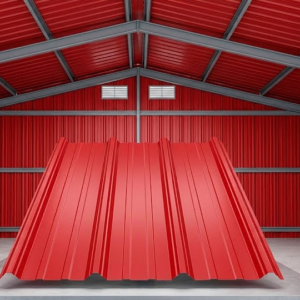
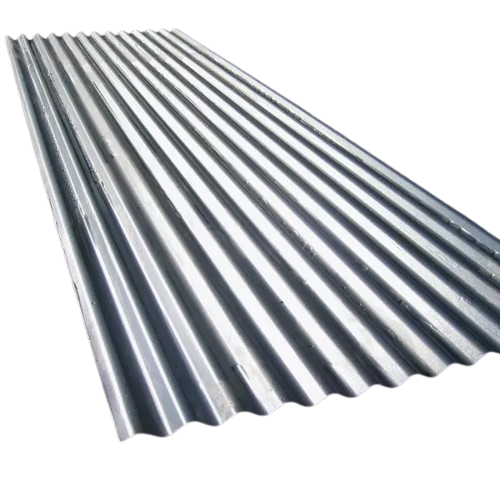
6. Aesthetic Versatility: Available in multiple profile types — corrugated, trapezoidal, and tiled — and compatible with pre-painted color coatings, galvalume roofing sheets meet both functional and architectural requirements without compromising on appearance.
7. Extended Service Life: Under normal atmospheric exposure conditions, galvalume roofing can deliver 25–40 years of reliable performance with minimal maintenance, making it a cost-effective choice for long-term roofing investments.
| Parameter | Spetsifikatsiya |
|---|---|
| Product Name | Galvalume Roofing Sheet |
| Qalinlik diapazoni | 0.12 – 2.0 mm |
| Kenglik diapazoni | 600 – 1500 mm |
| Length Range | 1000 – 11000 mm (custom lengths available) |
| Coating Mass | AZ30 – AZ150 g/m² |
| Coating Composition | 55% Aluminum / 43.4% Zinc / 1.6% Silicon |
| Profile Types | Corrugated, Trapezoidal, Tiled |
| Base Materials | DX51D+AZ, DX52D+AZ, DX53D+AZ, Q235+AZ, Q345+AZ, SGCC+AZ |
| Yuzani ishlov berish | Oiling, passivation, anti-fingerprint (optional) |
| Applicable Standards | GB, EN, JIS |
| Minimum Order Quantity | 10 Tons |
| Qadoqlash | Standard export packaging with protective layering |
| Thickness (mm) | Weight (kg/m²) |
|---|---|
| 0.3 | 2.37 |
| 0.4 | 3.16 |
| 0.5 | 3.95 |
| 0.6 | 4.74 |
| 0.7 | 5.53 |
| 0.8 | 6.32 |
| 0.9 | 7.11 |
| 1.0 | 7.85 |
| 1.2 | 9.42 |
| 1.5 | 11.78 |
| 2.0 | 15.70 |
Weight Calculation Guide: For your logistics planning and project estimates, use this theoretical formula: Total weight (kg) = [7.85 × length (m) × width (m) × thickness (mm)] + [(coating thickness × density) × length (m) × width (m) / 1000]. It’s a highly reliable baseline for calculating freight. This formula is recommended for project estimation and logistics planning.
Galvalume roofing sheets are produced through two primary forming methods depending on the desired profile:
Corrugated Profile Production: First, we take the steel coils and cut them to your exact dimensions using fixed-length cutting equipment. From there, they run through plate-pressing machinery to create that classic corrugated wave. This two-step process guarantees perfect dimensional accuracy and a consistent pattern on every single sheet. This two-stage process ensures dimensional accuracy and consistent wave geometry across each sheet.
Trapezoidal & Tiled Profiles: Steel coils feed directly into continuous roll-forming lines where the profile is shaped in a single pass, with cutting performed after forming. This direct-feed method is efficient for high-volume orders and maintains uniform profile depth and spacing.
The base galvalume coating is applied via a continuous hot-dip process at the steel mill, ensuring uniform coating distribution and strong metallurgical bonding to the steel substrate.
For optimal performance and service life, the following installation practices are suggested based on industry experience:
1. Substructure Preparation: It is recommended to ensure purlin spacing matches the load-bearing capacity of the selected sheet thickness. Typical purlin spacing ranges from 1.0 m to 1.5 m for 0.5 mm sheets under standard wind loads.
2. Overlap Guidelines: Side laps of at least one full corrugation are suggested for corrugated profiles. End laps of 150–250 mm are typical for low-slope roofs (below 15°), with reduced overlap acceptable for steeper pitches.
3. Fastener Selection: Self-drilling screws with EPDM sealing washers are recommended to match the coating grade. Stainless steel or aluminum-zinc coated fasteners are suggested for compatibility and long-term corrosion performance.
4. Cutting On-Site: When field cutting is required, power shears or nibblers are suggested rather than abrasive cutting discs, which can generate heat that damages the coating at cut edges. Any exposed steel edges should be touched up with zinc-rich repair paint as a best practice.
5. Handling and Storage: Sheets should be stored under cover, elevated from ground contact, and with adequate ventilation between bundles. When lifting, spreader bars and fabric slings are recommended to prevent surface damage.
A range of matching accessories is available to complete roofing installations. These are offered as compatible options for buyers seeking a single-supplier procurement solution:
1. Integrated Supply Chain: With over 13 years of production and export experience, BOMIS operates a complete supply chain covering steel coil sourcing, coating, forming, and global logistics — providing wholesale buyers with a streamlined procurement experience.
2. Factory-Direct Customization: Need fixed-length cuts, specialized press forming, or custom punching? We handle all that in-house. When your shipment arrives, it’s exactly to your project specs—no need to waste time and money on secondary processing.without the need for secondary processing at the destination.
3. Quality Assurance Through Standards Compliance: Products are manufactured to GB, EN, and JIS standards, with material certifications and mill test reports available upon request to support project documentation requirements.
4. Multi-Language Commercial Support: Professional customer service teams covering English, Russian, and Spanish markets serve buyers across more than 120 countries, supporting both pre-sales technical consultation and post-sales logistics coordination.
5. Efficient Production Lead Times: In-house production lines — including galvalume coil production, precision cutting, and multi-profile press forming equipment — enable competitive lead times for both standard specification orders and custom requirements.
Galvalume roofing uses an aluminum-zinc alloy coating (55% Al / 43.4% Zn), while galvanized roofing uses a pure zinc coating. The aluminum component in galvalume provides a durable barrier layer, while the zinc offers galvanic protection at cut edges. The combined effect typically results in 2–4 times greater corrosion resistance compared to standard galvanized sheets. Additionally, galvalume sheets offer approximately 3% more coverage per ton due to lower coating density.
For coastal or high-corrosion environments, AZ100 to AZ150 coating grades are typically suggested. The heavier coating mass provides additional protection against salt-laden air and humidity exposure. For inland applications with moderate atmospheric conditions, AZ50 to AZ70 grades generally provide sufficient service life.
Our standard minimum order starts at 10 tons. Generally, you’re looking at a 15 to 30-day production window for standard specs. If you need custom profiles, it might take a bit longer. Feel free to check in with us during your inquiry so we can give you the exact lead time based on current factory schedules.
The standard minimum order quantity is 10 tons. Lead times vary based on order specifications and current production scheduling — typical production windows range from 15 to 30 days for standard specifications, with custom profiles or specialized surface treatments potentially extending this timeline. It is recommended to confirm current lead times at the time of inquiry.
Yes. Galvalume sheets provide an excellent substrate for pre-painted coatings. The smooth, passivated surface accepts a wide range of paint systems, including polyester (PE), silicon-modified polyester (SMP), and polyvinylidene fluoride (PVDF) topcoats. Color options can be referenced from standard RAL charts, and custom color matching may be available for volume orders.
Standard export packaging includes moisture-resistant inner wrapping, protective interleaving between sheets, steel edge protectors, and secure steel strapping on fumigated wooden pallets or in wooden crates. Custom packaging specifications can be accommodated for project-specific handling or destination-country requirements — it is recommended to discuss packaging preferences during order confirmation.
Mill test certificates (MTC) confirming chemical composition, mechanical properties, and coating mass are available upon request at the time of order. Third-party inspection services such as SGS testing can typically be arranged for qualifying order volumes.