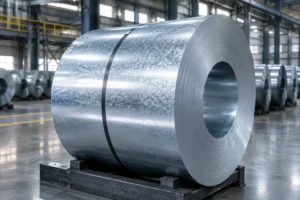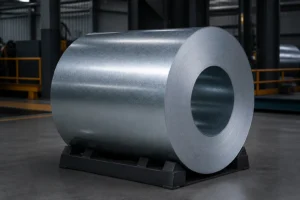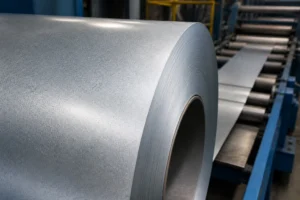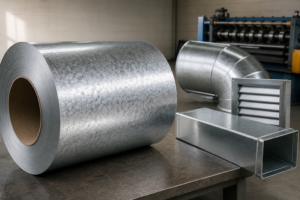










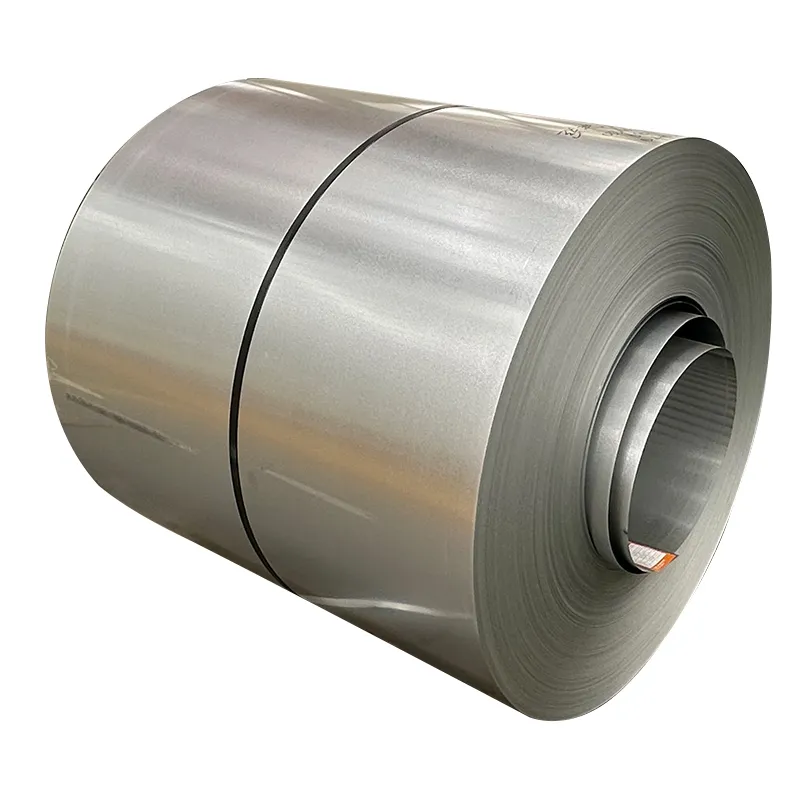
AI Takeaway. Galvalume steel coil (also known as Aluzinc and Zincalume sheet in Australia and New Zealand) is Hot-dip aluminum-zinc coated steel sheet. It is comprised of approximately 55% aluminium, 43.4% zinc and 1.6% silicon. Conventional galvanised sheet metal is less resistant to corrosion and heat than the aluminium barrier and sacrificial zinc layer, and the price difference is negligible. The number after AZ indicates the total weight of coating on both sides (g/m2). AZ50=50 grammes, AZ150=150 grammes. AZ100 is recommended for roof applications, AZ150 for coastal and industrial areas. Please indicate the grade: DX51D is semi-formed. S250GD and S350GD are load-bearing components. Please note the following five points before placing your order: Thickness, Width, AZ value, Surface treatment (Passivation/Oil coating) and Warranty. BOMIS is available in thicknesses of 0.12 to 2.0 mm, widths of 600 to 1500 mm and in grade classes AZ50 to AZ150. Specifications are listed and we confirm availability in 24 hours.
Galvalume Steel Coil – Full Guide: AZ50-AZ150, Grade Classes & Buying Criteria.
What is Galvalume, and how does it differ from galvanised sheet metal, has been a frequently asked question in the steel industry recently.
This question merits a serious answer. Based on our website search data, “Galvalume steel coil” is one of the most searched terms without clicks. Apparently a lot of people are curious about this, but haven’t found a comprehensive explanation yet. This guide is designed to bridge that gap.
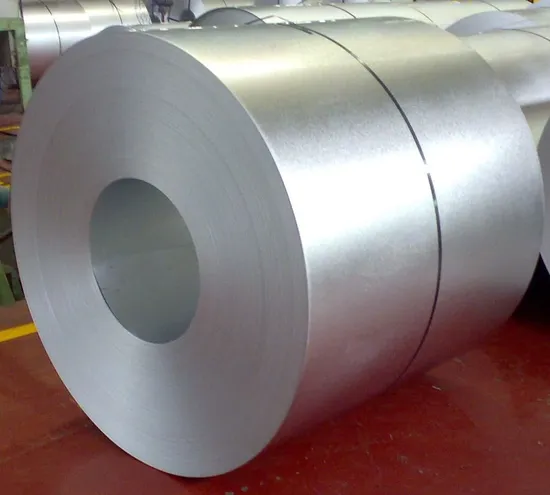
Galvalume is simply steel with an aluminum-zinc coating. This alloy is comprised of about 55% aluminium, 43.4% zinc and 1.6% silicon. The aluminium layer is for corrosion resistance, the zinc layer prevents rust to penetrate, and the silicon bonds the coating to the steel sheet strongly. This combination gives the coil a longer life and higher temperature resistance than conventional hot-dip galvanising (GI) in most environments.
Usually, such questions from buyers mean a certain product. It can be warehouse roofs, solar mounts, ventilation ducts, or housings for household appliances. Even within Galvalume, AZ50 and AZ150 are two completely different things, so the choice varies greatly depending on the product. This article is therefore not theoretical but explains four points directly: What is Galvalume, how is it different from galvanised steel, how do you read the AZ number and what should you look out for before placing an order?
The specifications in this article are all based on what BOMIS actually produces (thickness 0.12-2.0mm, width 600-1500mm, AZ50-AZ150, grades DX51D/S250GD/S350GD), which are not theoretical data from the Internet. Also you can contact the supplier directly with your requirements after reading this article.
First, let’s define the denomination and coating of the Galvalume/Aluzinc steel strip.
First, on the title: There are three different names for the same thing. The most common designation is galvalume. Aluzinc is a common roofing material in Latin America and some countries of Europe. Customers there use “galvalume bobina” or “aluzinc strip” for the same steel strip. Zincalume is a trademark in Australia and New Zealand. Important to note: whatever you order, you will get the same product, whatever they are called.
The coating, which was applied to the steel strip by a hot-dip galvanising process, was 55% aluminium, 43.4% zinc, and 1.6% silicon. Why use a mixture of two metals rather than pure zinc? Because each material has a definite function. Aluminium develops a dense oxide film on the surface that protects against air and moisture. This is known as barrier protection and the pipe lasts a long time without corroding. Zinc is more reactive than steel, and if the coating is damaged or worn away exposing the steel, the zinc sacrifices itself first to protect the steel substrate. This is referred to as sacrificial anode protection, and any pipe damage heals itself. Silicon prevents the formation of a brittle alloy layer between aluminium and zinc and the steel substrate during hot-dip galvanising and keeps the coating from peeling off when the pipe is bent.
What this combination means in practice: In the atmosphere and most industrial environments, Galvalume is more durable than galvanised sheet metal of the same weight. Even at long term operating temperatures of about 300 °C the surface discoloration and degradation of performance occur much more slowly. Galvalume is a better choice than galvanised sheet metal for non-critical applications or those that do not involve very high temperatures, such as appliance ovens, range hoods and roofs.
Hot-dip galvanising, thickness control using an Air knife, and cooling are the steps in the process that are similar to those for galvanised sheet metal. The difference lies in the composition of the galvanising solution and the temperature regulation. Aluminium is sensitive to bath impurities, the processing window is tighter than for galvanising and consistency can be a problem for Galvalume producers. That’s why we have included the quality of the steel mill in our purchasing criteria.
Galvalume vs. Galvanised Sheet Metal: What’s the Difference? What type of roofing do you need?
The first thing that most people ask about is “roofs”. Roofing materials must resist three types of stress: rain, UV radiation, and rapid temperature changes. Galvalume resists discoloration from direct sunlight better, has a denser coating less prone to the white rust that often occurs on galvanised sheets, and its protective aluminium oxide layer retards corrosion in humid environments.
Galvanised sheets are not so bad, though, and have advantages in either case. Part of the reason is the very corrosive coastal environment: In areas affected by sea spray and direct salt spray, the protection offered by a pure zinc coating is even better than that of aluminum-zinc and the corrosion resistance is more immediate. Thus many older coastal construction projects are covered in heavy zinc coatings (Z275 or better). Another plus is the weld beads. Welding galvanised sheet metal takes less labour. Galvalume has aluminium in it. Surface to be treated before welding. As for zinc, it is easier to work with than aluminium oxide and welders are most aware of this in practice.
The matter of cutting, is explained separately. The steel substrate is exposed with every cut. The galvanised sheets are stabilised at the cut by a sacrificial zinc anode. Galvalume cuts also have self-healing properties, but this effect is less pronounced than with pure zinc because of the higher aluminium content. For use in coastal projects, AZ150 Galvalume should be used or the edges should be sealed with cuts. All edges seal.
In terms of price the two materials are pretty much on par, although prices for zinc and aluminium fluctuate. It’s only a matter of time before it becomes obvious which material is more expensive and which material is less expensive. But the cost difference is determined by the total cost over the entire service life. Galvanised sheet metal may already need replacing in 20 years, but Galvalume roofs are often still in perfect shape. Here’s a handy tip to help you decide: For inland roofs and enclosures, compare the prices and delivery times of both options. Galvalume with higher AZ value is recommended for coastal, industrial and high humidity areas. If you are in an area near the sea where only splash water is present, you might want to talk to your planner about the durability of a thicker galvanised sheet metal.
What Do AZ50, AZ100 and AZ150 Mean? How to Choose the Coating Value
Let’s begin with the simplest question. The number following “AZ” is the coating weight in g/m² based on the total area of both sides. AZ50 is 50 grammes per square metre (on both sides) and AZ150 is 150 grammes. The higher the value, the thicker the coating, the longer the corrosion resistance, and the higher the cost per unit.
AZ50 is the lightest coating and is suitable for indoor environments with low corrosion exposure such as ventilation ducts, ceiling structures and interior panels of household appliances. The service life is limited, so it is not fit for use outside.
AZ100 can be used as the base option: It is the least expensive option for roofs, wall panels and components in inland climate zones and is the preferred option for most projects.
AZ120-AZ150 only for extreme corrosion exposure environments. Use AZ150 directly for applications with a 25-year service life, such as in coastal cities, industrial facilities, around chemical plants and on solar panel mounts. Don’t rob yourself of this. Coating cost is only a tiny fraction of the sheet price. The sheet needs to be replaced and post processing is mandatory.
A common misconception. Bigger AZ values are not always better. Too thick a coating will adversely affect bending properties and increase the likelihood of cracking when bending to small radii or rolling complex cross-sections. Tell your supplier how you want it processed when you order.
Different things, don’t confuse the AZ value with the grade. The steel matrix DX51D has a partially formed hardness and can be easily rolled, bent and punched. S250GD has the strength of 250MPa which is enough for general purlins and Corrugated sheet. The S350GD has a strength of 350 MPa. Heavy duty purlins and structural components? Looking for Solar Mounting Structures? Industry standards: JIS G3322 CGLCC is the Japanese standard for color-coated substrate, and ASTM A792 is the North American standard for Galvalume, EN 10346 DX51D + AZ150 is designated as EN. MTC provides products in accordance with the corresponding standards, depending on the export market.
Things to consider before buying Galvalume coils. A good overview of common forms and applications.
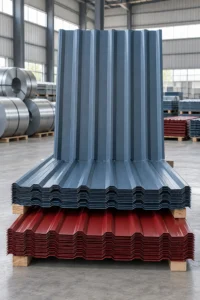
First, on forms: With Galvalume, it’s not just about quantity. The most common form of purchase is whole coils, delivered directly from the steel mill. Purlins, brackets, and keels are made from slit strip, which is created by cutting wide coils into narrow strips. Processed parts below Corrugated sheet, trapezoidal sheets, flat sheets and finished sheets for roof and wall constructions.
Classification by application. The biggest use area is for roof and wall cladding. Galvalume is mainly used for building roofs. The fastest growing are solar mounting systems, with photovoltaic guide rails and steel C-channels being predominantly Galvalume products. Demand for ducts and cable trays is stable and consistent. Heat resistant materials are used for side panels of appliances, furnace linings, exhaust pipes etc. These have heat resistant surface finish.
Please check this list before you order.
Thickness, width. BOMIS is available in thicknesses from 0.12 to 2.0 mm and widths from 600 to 1500 mm. The most commonly used roofing fabric for the Latin American market is sold in 1,200 mm widths and 0.25-0.45 mm thicknesses. This is the standard material for light weight steel roof tiles. The tolerances are consistent with standards and generally ±10%, but the actual tolerance depends on the warranty.
AZ value and grade: As stated above, both must be stated when ordering, otherwise the wrong price might be quoted.
Surface treatment: Standard preparations for shipment are passivation (with or without chromium) and oiling. Passivation prevents white rust and oiling prevents scratches. Degreasing is only required prior to further processing upon arrival at the port. Export parts to be chromated & oiled.
Weight and inner diameter of one coil. Inner diameters of 508 mm and 610 mm are the industry standard. The flat wire is able to lift the coil and the plan for dismantling the control cabinet depends on the weight of the coil. Please ask us for details before requesting a quotation.
Mill Test Certificate (MTC). Steel coils are raw material and must be further processed. Without an MTC, no identification document. The steel mill, brand, batch, composition and plating weight are also listed in this document and appendices to the contract.
Packaging not defined. Steel coils can be damaged during transport over the equator and by condensation. Waterproof packaging with desiccants and edge protection is therefore standard for export. Please see the previous guide for export packaging for specific details.
Common Questions.
Roofing Sheet Metal: Galvalume or Galvanised?
Both are fine for typical inland roofs, compare prices and delivery times. AZ150: Coastal and industrial areas.
Does Galvalume corrode?
Yeah. It’s not stainless steel. If the edges are exposed and the steel is exposed to salt spray for long periods of time, it will rust. This can be avoided by choosing the proper AZ value and sealing the cut edges.
What is the size difference between AZ50 and AZ150?
The figures are for total coating weight (g/m2) on both sides of the material. 150 is 50 * 3. AZ50 is enough for indoor use, AZ100 or more is recommended for outdoor roofs and AZ150 is a must for coastal areas.
Is it weldable or roll formed?
Common process Rolling forming is You can weld. The coating contains aluminium. Surface should be clean before welding. Do not weld directly.
Is Zincalume the same as Galvalume?
They’re the same product. While Aluzinc is frequently used in Latin America, Zincalume is a trade name in Australia and New Zealand.
What BOMIS series do you have?
Thickness 0.12-2.0mm, Width 600-1500mm, AZ50-AZ150, Grade DX51D/S250GD/S350GD, Coils, Slit strip, Corrugated sheet
To conclude.
Galvalume is not a substitute for galvanised sheet metal but an alternative that costs the same but is more resistant to corrosion and heat, but requires more complicated machining and welding. Make sure of four things before buying – AZ value, brand, surface treatment and quality guaranty. The supplier handles it from there.
BOMIS NEW MATERIAL CO., LIMITED is distributor of PPGI/PPGL/GI/GL coils and fabricated parts to Latin America, South-east Asia, Middle East and Africa. If you are in roofing, solar panel mounting systems or wholesale please tell the AZ value and thickness. We will reply within 24 hours to confirm availability and provide you with a quote. To get an idea of what the end product will look like we recommend looking at our Galvalume roof tile series.