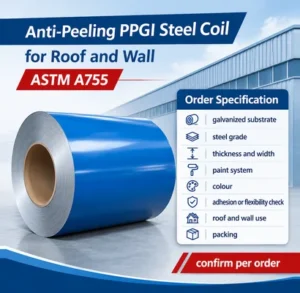
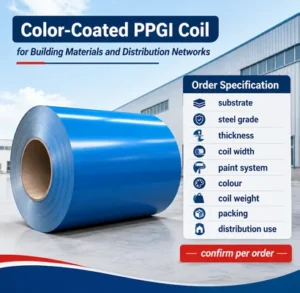
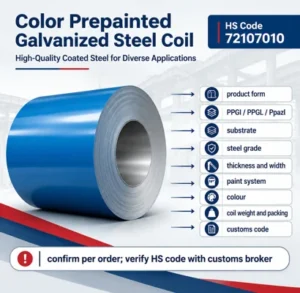
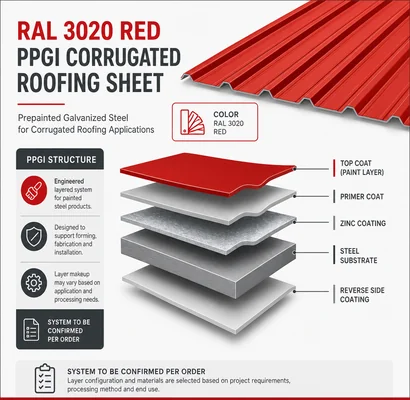
RAL 3020 red PPGI corrugated roofing sheet should be ordered as a complete system, not as a colour name alone. The buyer needs to confirm the galvanized substrate, steel grade, base-metal thickness, zinc coating designation, paint system, top and reverse-side treatment, profile, effective cover width, cut length, quantity and packing. RAL 3020 provides a clear colour reference, but an approved sample or colour record should stay with the order because screen colours and production batches can differ. The buyer also needs to separate parent-coil supply from finished corrugated sheet supply. A coil order must state the forming route and the dimensions needed by the roll-forming line. A finished-sheet order must state the profile, overlap and panel schedule. PE, SMP, HDP and PVDF are not interchangeable labels; the selected system should follow the exposure, forming route and appearance requirement. BOMIS Steel can review the complete schedule and confirm which PPGI combination is available for the project. Open fields should remain marked “confirm per order” until the technical and commercial details are agreed.

Why should buyers specify the full RAL 3020 PPGI roofing system?
A red roof can look simple on a colour board. The purchase specification is not simple. RAL 3020 identifies the intended colour family, but the colour does not identify the steel grade, substrate coating, paint chemistry, thickness or panel geometry. Those fields affect forming, handling, fit, appearance and the way the roof package is priced.
Start with the product format. A supplier may quote a parent PPGI coil for a buyer who owns the roll-forming line, or a finished corrugated roofing sheet for a buyer who needs ready-to-install panels. The two offers use different dimensional language. Coil supply centres on incoming width, thickness, coil weight, edge condition and forming compatibility. Finished-sheet supply centres on effective cover width, overall width, profile, overlap and cut length.
Then record the substrate route. PPGI means prepainted galvanized steel. The galvanized coating designation and steel grade still need confirmation. A colour name does not replace those fields. The order record should show the substrate, coating designation, grade, temper or forming requirement where relevant, and the tolerance basis. If a project is considering PPGL, keep that as a separate option rather than combining PPGI and PPGL in one ambiguous line.
The paint system also deserves its own line. PE, SMP, HDP and PVDF can serve different exposure and appearance requirements, subject to the supplier’s available range and the project specification. The top-coat, primer and reverse-side treatment should be confirmed together. A buyer comparing two quotations should check that both quotations refer to the same coating system before comparing price.
Finally, link the colour approval to the physical order. Keep the approved RAL reference, sample decision, visible face and finish together with the quotation. That record gives production, forming and replacement-panel purchasing one reference to follow.
How should RAL 3020 colour approval be handled?
RAL 3020 is useful because it gives the buyer and supplier a shared colour reference. It does not remove the need for approval. A monitor, printed image, painted sample and finished coil can show different visual results because lighting, gloss, texture and viewing angle change the appearance.
Put the colour decision into the enquiry as a controlled field. Write the requested colour as RAL 3020 red, then state whether the buyer requires a physical sample, a supplier sample, a previous approved reference or another colour-approval route. Record the visible side and the expected finish. Matte and gloss surfaces can make the same red appear different even when the colour code is unchanged.
Use the same record for replacement panels. If the building may need repairs later, the owner should keep the original colour reference, product format and coating system. A replacement panel made from another substrate or coating route may not match the original surface even when the colour name is the same.
Colour approval should not be separated from exposure. Inland roofing, coastal buildings, industrial sites and agricultural structures may require different coating discussions. The buyer should ask the supplier to confirm the available paint system for the environment, forming process and expected appearance. Do not select a coating only because it appears beside the colour in a catalogue.
For a roll-forming project, approve the colour before the coil is slit or formed where possible. The forming process can expose the cut edge and create a different visual relationship between the crest, valley and overlap. For finished sheets, inspect the surface and edge protection requirements in the same approval step.
What dimensions must be confirmed for coil and corrugated sheet supply?
Dimensions are where many roofing enquiries become unclear. A buyer may write “roofing sheet width” without saying whether the number means the parent coil width, the overall formed width or the effective cover width. Those values are not interchangeable.
For parent-coil supply, confirm base-metal thickness, incoming width, coil inside diameter if required by the line, outside diameter or maximum coil weight where relevant, edge condition and the forming direction. The roll-forming line may impose limits that are not visible in a finished-panel catalogue. Ask the forming operator to approve the dimensional schedule before the supplier releases production.
For finished corrugated roofing sheet, confirm profile, overall width, effective cover width, cut length and overlap. The effective cover width is the part that covers the roof after adjacent sheets overlap. It is the number the installer uses for layout, while overall width is the physical panel dimension before overlap. A quotation that lists only one width can leave the buyer with an incomplete installation calculation.
Profile geometry also affects the order. Crest height, pitch, valley shape and overlap direction should match the purlin spacing, fastener position and roof drawing. The buyer does not need to invent a profile code if one is not already approved; a drawing, sample panel or clear section sketch can give the supplier a usable starting point.
Cut length needs the same care. State whether the length is fixed by the roof schedule, supplied in standard bundles or adjusted after the supplier reviews the drawing. Confirm the cut-edge treatment and packing method for long panels. A red painted surface can be protected from scratches only when the handling and bundle requirements are known before production.
Use a two-line dimensional record when both formats are possible: “parent coil: confirm thickness and incoming width” and “finished sheet: confirm overall width, effective cover width, profile and cut length.” That simple separation helps purchasing compare like with like.
Which coating and substrate questions should the buyer ask?
A complete PPGI specification connects the steel substrate to the coating system and the use environment. The buyer should ask which galvanized substrate is available, what grade is proposed, which coating designation applies, and how the material will be formed. The supplier should then confirm the paint system, finish, visible face and reverse-side treatment.
PE can be considered for many standard building-envelope projects where the exposure and forming conditions are compatible. SMP, HDP or PVDF may be considered when the project places more emphasis on weathering, colour retention or surface performance. The correct selection depends on the confirmed product system and the supplier’s available production route. A general label such as “high quality paint” does not identify the coating.
The buyer should ask for the nominal top-coat and primer arrangement, reverse-side coating, gloss or finish, and any protective film requirement. The exact values must be confirmed per order. Avoid writing a fixed coating thickness into the enquiry unless the project specification already requires it.
Forming is another decision point. A coating system that looks suitable on a flat sample still needs to pass through the intended bending or roll-forming route. Confirm minimum forming requirements, profile geometry and whether the finished panel will expose a cut edge. The supplier can then check the proposed combination before production.
PPGI is not automatically the correct choice for every roof. If the buyer’s design calls for an aluminium-zinc substrate, the enquiry should be written as PPGL and evaluated separately. Keeping PPGI and PPGL distinct prevents coating mass, substrate and service assumptions from being mixed in one quotation.
How should buyers compare quotations for RAL 3020 roofing material?
Compare the technical schedule before comparing the price. A low number may represent a parent coil while another number represents formed, cut-to-length panels. One quotation may include a different substrate, paint system, packing method or delivery basis. The buyer needs to normalize these fields first.
Use a quotation checklist with the product format, RAL reference, colour-approval route, galvanized substrate, steel grade, coating designation, base-metal thickness, width, profile, effective cover width, cut length, paint system, finish, quantity, packing and destination. Ask the supplier to return the same checklist with confirmed values and open fields clearly marked.
Check whether the quoted thickness is base metal thickness or total coated thickness. Confirm how width is measured. Confirm whether the price covers slitting, roll forming, cut-to-length work, protective film, bundle packing and export documents. These details change the delivered product even when the headline colour is identical.
Quantity also needs a clear unit. Coil supply may be quoted by tonne, while finished sheet may be quoted by tonne, bundle, piece or square metre. Ask the supplier to state the billing basis and estimated bundle or coil information. Keep the destination and packing requirement beside the quantity because container loading can affect the final commercial calculation.
For a first order, request a clear technical confirmation rather than a long list of unverified claims. BOMIS Steel can review the buyer’s roof drawing, colour reference and procurement schedule, then return the available PPGI route for approval. The buyer can make a fair comparison when each offer describes the same material and processing scope.
FAQ: What do buyers ask about RAL 3020 red PPGI roofing sheet?
Is RAL 3020 a steel grade?
No. RAL 3020 is a colour reference. The steel grade, galvanized coating designation, thickness and paint system must be confirmed separately.
Is the product supplied as coil or corrugated sheet?
Either format may be discussed, but the quotation must identify the format. Coil supply needs forming-line dimensions; finished sheet supply needs profile, effective cover width and cut length.
Can the same colour be used for wall cladding?
It can be considered for wall cladding when the substrate, coating system, profile and project exposure are suitable. Confirm the visible face and finish for the wall application.
Should the buyer specify effective cover width?
Yes. Effective cover width controls the installed roof area after overlap. Record it separately from overall panel width so the quantity calculation is clear.
Which paint system is best for this red roofing material?
There is no single answer without the exposure and forming details. PE, SMP, HDP or PVDF may be considered; ask the supplier to confirm the available system for the project.
Suka
RAL 3020 red PPGI corrugated roofing sheet is easiest to buy when the colour, steel, coating and profile are written as one coordinated schedule. Confirm whether the requirement is parent coil or finished sheet, then record the substrate, grade, dimensions, paint system, colour approval, quantity and packing. BOMIS Steel can review the project brief and identify the fields that need confirmation before production.

Related reading: customized color coated corrugated roofing sheets, PPGI vs PPGL buying guide, mpe galvanized steel coil buyer guide.