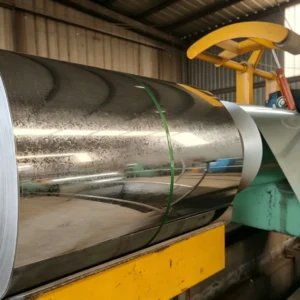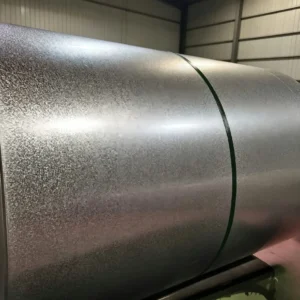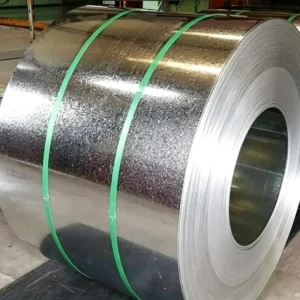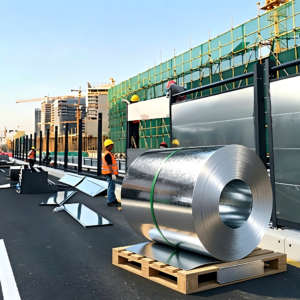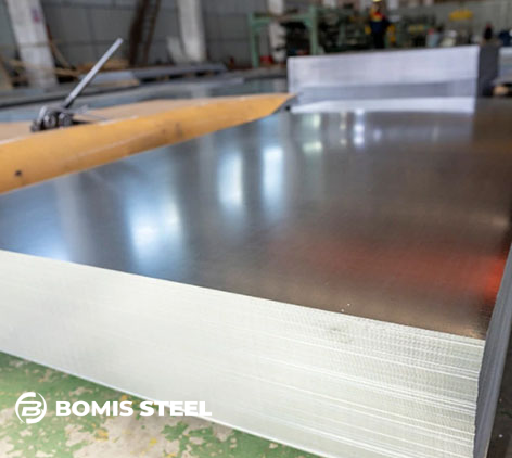
Zero spangle galvanized iron (GI) sheet is a hot-dip galvanized steel product manufactured with a controlled solidification process that suppresses the visible zinc crystal pattern — known as spangle — on the coated surface. The result is a uniformly smooth, matte-to-satin finish with a homogeneous zinc layer that provides consistent corrosion protection across the entire sheet area. This surface characteristic makes zero spangle GI sheet the preferred substrate for applications where subsequent painting, powder coating, or lamination is required, as well as for end-use products where a clean, blemish-free appearance is a quality specification. Available in a wide gauge range and slit to custom widths, zero spangle GI sheet serves the automotive, appliance, electronics, and medical equipment industries where surface integrity directly impacts final product quality.
1. Uniform Smooth Surface: The controlled zinc bath chemistry and cooling process eliminates the dendritic crystal growth that produces visible spangle patterns. The resulting surface is flat and free of the characteristic “snowflake” or “fern-leaf” texture seen on regular spangle galvanized products. This smoothness is critical for downstream coating processes — a uniform substrate yields a uniform topcoat.
2. Superior Paint & Coating Adhesion: The absence of spangle-induced surface relief means paint, powder coating, and adhesive films bond to a consistent substrate profile. This reduces the risk of coating defects, orange-peel effects, or localized delamination that can occur when paint is applied over the peaks and valleys of a pronounced spangle pattern.
3. Consistent Zinc Layer Distribution: Zero spangle production involves tighter process control over bath temperature, withdrawal speed, and air-knife wiping parameters, resulting in a more uniformly distributed zinc coating thickness across the sheet width and length. Uniform zinc distribution translates to predictable corrosion performance in service.
4. Excellent Formability: The fine-grained zinc microstructure characteristic of zero spangle products supports good drawability and bend performance. The coating remains adherent through press forming, deep drawing, roll forming, and moderate stretch-forming operations without powdering or flaking.
5. Clean Aesthetic for Visible Parts: For products where the galvanized surface remains exposed in the final assembly — such as internal structural brackets, chassis components, or equipment enclosures — zero spangle provides a professional, consistent metallic appearance without the visual distraction of spangle patterning.
The spangle pattern on conventional galvanized steel forms as the molten zinc coating solidifies on the steel strip surface during withdrawal from the zinc bath. Zinc crystal nucleation and dendritic growth produce the characteristic flower-like or star-shaped grains that become visible at the macro scale.
Zero spangle production suppresses this crystallization through several process controls:
| Nom du produit | Zero Spangle Galvanized Iron (GI) Sheet |
| Plage d'épaisseur | 0.12 mm – 5.0 mm (standard gauge range; heavier gauges up to 5.0 mm available on request) |
| Plage de largeur | 30 mm – 1,500 mm (slit strip to full-width sheet; custom widths accommodated) |
| Longueur | Custom cut to buyer specification; standard sheet sizes and coil form both available |
| Nuances de métaux de base | DX51D, DX52D, DX53D, DX54D (EN 10346); Q235, Q345 (GB/T 700); SGCC, SGCD (JIS G 3302); CS Type A/B/C (ASTM A653) |
| Poids du revêtement de zinc | Z30 – Z275 (30 – 275 g/m²), single-side or double-side; G30 – G90 (ASTM A653 equivalent) |
| Spangle Classification | Zero spangle (S-type per EN 10346 / minimized spangle per ASTM A653) |
| Traitement de surface | Chromate passivation, anti-fingerprint coating, or oiled — specified per downstream processing requirements |
| Normes applicables | EN 10346, ASTM A653/A653M, JIS G 3302, GB/T 2518 |
| Form Availability | Coil, slit strip, cut-to-length sheet, and corrugated sheet profile |
| Services de traitement | Slitting, cut-to-length, press blanking, punching, roll forming, and corrugated profiling |
| Quantité minimale de commande | 10 metric tons per specification |
| Conditionnement | Standard seaworthy export packaging with VCI moisture barrier, edge protection, and steel strapping on timber pallets; coil packaging with circumferential strapping and bore protection |
| Délai de mise en œuvre | 15 – 25 working days from order confirmation and technical approval |
| Quotation Basis | EXW, FOB, CIF, or CFR — negotiable per order volume and destination |
| Characteristic | Zero Spangle GI Sheet | Regular Spangle GI Sheet |
| Surface Appearance | Smooth, uniform, matte-to-satin — no visible crystal pattern | Visible snowflake, star, or fern-leaf crystal pattern; variable grain size |
| Surface Roughness (Ra) | Typically 0.5 – 1.2 μm | Typically 1.5 – 3.5 μm |
| Paint/Coating Adhesion | Excellent — uniform substrate yields consistent topcoat finish | Good but may exhibit localized variation over spangle peaks |
| Zinc Distribution Uniformity | Highly uniform — tighter process control | Slightly more variable due to spangle crystal topography |
| Résistance à la corrosion | Excellent — uniform zinc coverage across entire surface | Comparable zinc weight provides similar bulk protection; surface uniformity may influence localized initiation |
| Formabilité | Good drawability; coating integrity maintained through forming | Comparable mechanical performance; spangle pattern may telegraph through thin topcoats |
| Coût | Slightly higher — reflects tighter process controls | Lower — less demanding production parameters |
| Applications typiques | Automotive panels, appliance shells, electronics enclosures, medical devices, painted/coated products | General construction, structural members, roofing, framing, industrial shelving, non-appearance parts |
Forming & Stamping: Zero spangle GI sheet is suitable for bending, press braking, roll forming, stamping, and moderate deep drawing. The zinc coating is metallurgically bonded and remains adherent through typical forming strains. For deep-draw applications, DX53D or DX54D deep-drawing grades are recommended, and a pre-production trial with the specific tooling set is suggested to validate performance.
Welding: Resistance spot welding and seam welding can be performed through the zinc coating using appropriate electrode dressing schedules. The zero spangle surface, being less textured than regular spangle, provides consistent electrical contact resistance at the electrode interface — an advantage for automated welding lines. For arc welding processes, adequate fume extraction is required for zinc oxide, and weld zones should be reconditioned with zinc-rich paint to restore corrosion protection.
Painting & Coating: The smooth surface of zero spangle GI sheet reduces paint consumption compared to textured spangle surfaces, as less material is needed to fill surface relief. For liquid painting, a light surface abrasion or chemical conversion coating (phosphate or chromate) is recommended to maximize topcoat adhesion. Powder coating adhesion is excellent on properly degreased zero spangle surfaces.
Storage & Handling: Store sheets and coils in dry, covered conditions. If chromate-passivated or oiled, the surface protection remains effective for approximately 3–6 months in normal warehouse environments. For extended storage, re-oiling or re-application of protective film may be required. Handle sheets on edge and use fabric or rubber-contact lifting equipment to preserve the surface finish.
Zero spangle refers to a galvanized surface with no visible zinc crystal pattern. It is achieved through controlled zinc bath chemistry and accelerated post-coating cooling. The performance impact is primarily in surface quality: zero spangle GI sheet offers a smoother surface that is better suited for painting, coating, and applications where surface appearance matters. Corrosion resistance at equivalent zinc coating weights is comparable to regular spangle products.
Yes. The smooth, uniform metallic finish of zero spangle GI sheet is aesthetically acceptable for many unpainted applications — electrical enclosures, internal brackets, shelving, and general fabrication — where the surface is visible but a premium painted finish is not required. The zinc coating alone provides the corrosion protection. For exterior or wet-environment exposure, painting or additional surface treatment is recommended.
Three standard post-treatment options are available: chromate passivation (provides temporary corrosion protection and improves paint adhesion), anti-fingerprint coating (a thin transparent organic film that prevents handling marks and provides mild corrosion protection — commonly specified for visible appliance and electronics parts), and rust-preventative oil (for uncoated storage and processing). The appropriate treatment depends on the downstream manufacturing process.
The standard MOQ is 10 metric tons per specification (grade, thickness, zinc coating weight, and surface treatment combination). The typical production lead time is 15–25 working days from order confirmation and receipt of deposit. Shipping transit time is additional and depends on the destination port and logistics mode.
Yes. Zero spangle GI is produced in coil form and can be supplied as full-width coils, slit strip (narrow coils down to 30 mm width), or cut-to-length sheets per the buyer’s dimensional specification. Corrugated sheet profiles can also be roll-formed from zero spangle substrate on request.
Zinc coating weights from Z30 to Z275 (30–275 g/m²) are available. The selection depends on the service environment: Z100–Z140 is typical for indoor and mild exterior applications; Z180–Z275 is recommended for exterior exposure, high-humidity environments, and coastal or industrial atmospheres. Our technical team can provide specific coating weight guidance against your project’s corrosivity category.
Standard documentation includes: mill test certificate (MTC per EN 10204), commercial invoice, packing list, bill of lading, and certificate of origin. Our manufacturing facility holds ISO 9001:2015 certification. CE marking, third-party inspection reports, and additional compliance documentation can be coordinated on request.