












Galvalume steel coil is usually the better pick for roofing and wall cladding. On broad, intact surfaces, its aluminum-zinc coating typically offers 2 to 4 times the corrosion resistance of galvanized, though real-world roof life across typical US climates is closer to 1.5 to 2 times. Galvanized costs less upfront and handles cut edges, scratches and drilled holes better. Both coatings struggle in severe marine exposure.
This guide covers how the coil is made, where it works, how to read a spec sheet (ASTM A792, coating weight, thickness), and what US buyers should verify before paying.
BOMIS STEEL is a factory-direct steel deep-processing manufacturer in Shandong, China, with roughly 1 million tons of production capacity. We make both GI and GL coils to custom coating weights, so we can supply either one based on what your site calls for.
Key takeaways
- Best use: Galvalume suits roofing and cladding on large exposed surfaces, especially in humid, rainy, high-UV or industrial air.
- Galvanized wins when: Budget is tight, the site is dry and inland, or cut edges and drilled holes are the main risk.
- Marine caution: Neither coating is ideal in severe marine exposure, such as direct salt spray. Specify a marine-rated system there.
- Spec it fully: Name the standard, grade, coating mass, thickness, width and coil dimensions, not just “Galvalume.”
- Verify before paying: Match the mill test certificate to your spec and arrange third-party inspection.
What is Galvalume steel coil, and how is it made?
Galvalume steel coil is carbon steel sheet coated on both sides with an aluminum-zinc alloy by a continuous hot-dip process, then supplied in coil form. The coating is roughly 55% aluminum, 43-45% zinc and about 1.5% silicon. Each element has a job: aluminum builds a stable barrier layer, zinc gives sacrificial protection where the coating gets damaged, and silicon controls the bond between coating and steel.
Steel strip runs through a molten aluminum-zinc bath on a continuous line, picks up the coating on both faces, and is recoiled. The steel core supplies strength, and the coating supplies corrosion resistance.
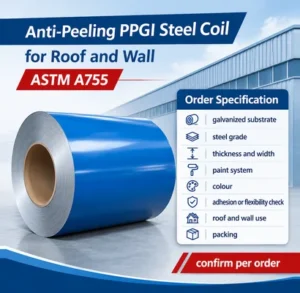
Bare and painted Galvalume are not the same product. Paint is a separate organic layer on top of the metallic coating. If you need color on roofing or cladding, prepainted PPGL is one option, and prepainted galvanized (PPGI) is another. We produce PPGI and PPGL on continuous color coating lines with PE, SMP, HDP and PVDF paint options, and we offer RAL color matching.
Galvalume vs. galvanized steel: which one wins for your project?
Galvalume generally gives better long-term corrosion resistance, while galvanized usually costs less upfront and protects cut edges better. Here’s how they stack up.
| Factor | Galvalume | Galvanized steel |
| Coating composition | Aluminum-zinc-silicon, about 55% aluminum and 43% zinc | Primarily zinc |
| Corrosion resistance (intact surfaces) | Usually 2 to 4 times better on broad surfaces | Good general protection, but zinc wears faster in prolonged moisture, salt or pollution |
| Cut edges and scratches | Strong barrier protection, but exposed edges can be more vulnerable until the aluminum-zinc alloy provides some protection over time | Sacrificial zinc is more forgiving at edges, scratches and drilled holes |
| Upfront cost | Often slightly higher | Usually lower |
| Lifecycle cost | Often better where longer life cuts maintenance or replacement | More economical for shorter-life or low-exposure projects |
| Conformabilidad | Less forgiving on tight bends | More formable |
The part most buyers miss: edges and bends
Galvalume wins on large exposed panels, but zinc’s sacrificial action makes galvanized more forgiving at cut edges and drilled holes. Galvalume’s coating is also more prone to damage on tight bends or deep forming. Bend radius and roll-forming practice matter, so tell your fabricator what you’re making.
The 2 to 4 times figure describes corrosion resistance on comparable intact surfaces, which is a different measure from service life. On lifespan, Englert Inc. puts Galvalume roofing at about 40-60 years and conventional galvanized at about 20-40. Across typical US climates, that works out to roughly 1.5 to 2 times the corrosion-resistant roofing life. Coating thickness, drainage, fastener treatment, exposure conditions and installation quality all move that number.
Which environment suits which coating?
- Choose Galvalume for humid, rainy, high-UV or industrial atmospheres, and for heat-reflective roofing.
- Choose galvanized for dry inland sites, fencing, agricultural uses, and projects where edge damage is the main risk.
- Use caution with both in severe marine exposure, and specify Galvalume carefully in strongly alkaline settings.
The rule of thumb: galvanized for the lowest upfront cost and moderate exposure, Galvalume when longer life justifies the price.
Where is Galvalume coil used, and where does it fall short?
Galvalume coil applications in construction start with roofing and wall cladding. They extend to siding, pre-engineered steel buildings, warehouses, gutters, downspouts and agricultural structures. Galvalume roofing coil is popular because it combines corrosion resistance, heat reflectivity and low maintenance on large spans.
In manufacturing, you’ll find it in refrigerator panels, air-conditioner housings, HVAC ductwork, solar mounting structures, equipment enclosures and transportation products. Painted Galvalume coil is common wherever the surface is visible.
Know the limits before you commit. Aggressive chemicals such as fertilizer, animal waste, and strong acids or alkalis accelerate coating breakdown. Galvanic contact with copper causes corrosion, and cut edges need detailing.
Metal roofs also expand with temperature and can transmit rain noise. The practical fix is compatible fasteners and flashings, edge protection, and insulation underlayment.
What specs should you check before ordering Galvalume coil?
Name the standard, base-steel grade, total coating mass, finished thickness, width and coil dimensions. ASTM A792/A792M is the main North American standard for 55% aluminum-zinc coated sheet. For international orders, you’ll also see EN 10346, JIS G3321 and AS 1397. Don’t confuse AZ designations with the G or Z designations for galvanized steel under ASTM A653.
Under ASTM A792/A792M, the coating designation specifies a combined two-side coating mass. A purchase order can add side-specific requirements, but that doesn’t change what the designation itself means. The table pairs inch-pound and metric designations, which are approximate equivalents rather than exact unit conversions:
| Denominación | Approximate total coating mass |
| AZ50 / AZM150 | 0.50 oz/ft² / about 150 g/m² |
| AZ55 / AZM165 | 0.55 oz/ft² / about 165 g/m² |
| AZ60 / AZM180 | 0.60 oz/ft² / about 180 g/m² |
| AZ70 / AZM210 | 0.70 oz/ft² / about 210 g/m² |
Steel grades include CS, FS, DS, SS (Grade 33 to 80) and HSLAS, so state both grade and class. Specify thickness in millimeters or inches rather than gauge alone, and say whether it’s measured before or after coating. Common widths are 914, 1,000, 1,219 and 1,250 mm. Also state the following:
- Slit width and edge condition
- Inside diameter (508 or 610 mm) and maximum outside diameter
- Coil weight
- Spangle
- Surface treatment (passivated, oiled, dry or anti-fingerprint)
Here’s a sample spec line you can copy: ASTM A792/A792M, SS Grade 50 Class 1, AZM150, 0.60 mm base thickness, 1,219 mm slit width, 508 mm ID, passivated and oiled, with mill test certificate and coating-mass verification.
How should importers, distributors and roofing manufacturers buy Galvalume coil?
Start with the mill test certificate. It should be coil-specific and report actual results, not just “pass”: grade, mechanical properties, coating mass, and coil or heat traceability. Match every line to your purchase spec, confirm the coating value is a two-side total, and ask how coating mass was tested. The reference method is weigh-strip-weigh, and XRF gauges give fast nondestructive checks. XRF needs calibration, so verify it against a gravimetric result when the numbers are critical or disputed.
Next, book third-party inspection from SGS, BV or Intertek before shipment. Have them check dimensions, coating weight, surface quality and packaging. On a container order, it’s cheap insurance.
Packaging deserves equal attention, because wet storage damage during ocean freight is a common risk. Look for dry coil, a sealed moisture barrier, edge and bore protection, desiccant for humid voyages, and a clean, watertight container. Mark packages “KEEP DRY,” and plan lead time and port schedules early so coils don’t sit exposed on a dock.
Finally, check the import side before you order. Confirm which US tariffs or trade remedies apply to your product and country of origin, get the country-of-origin documentation in order, and calculate the landed cost rather than comparing ex-works prices alone.
Why work with a factory-direct supplier like BOMIS STEEL?
We export worldwide on factory-direct terms. Our GL coils come in custom coating weights from AZ40 to AZ150. For projects where galvanized is the better call, our GI coils run from Z40 to Z275. Confirm the standard and two-side basis for these ranges against your spec before ordering.
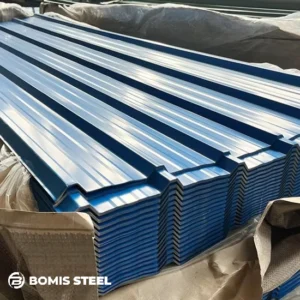
We back that with in-house quality testing, Mill Test Certificates, and third-party inspection support. If you need color, we offer PPGL, and we make corrugated roofing sheets and custom roll-formed profiles to your drawings or samples. Buying direct means you deal with the manufacturer itself, which suits distributors looking for a long-term supply partner. Send us your spec line and we’ll quote it.
Choosing the right Galvalume coil comes down to specs and supplier
The verdict: Galvalume for long-life roofing and cladding on large surfaces, galvanized for edge-heavy, budget or dry-site work, and extra care in marine and chemical settings. The buying checklist is short: standard, grade, coating mass, thickness, width, mill test certificate, inspection and packaging. Getting those items right can reduce purchasing and shipping risks considerably.
When you’re ready to price Galvalume steel coil, contact BOMIS STEEL with your project spec and we’ll send a quote.
Preguntas frecuentes
Can you paint Galvalume steel coil?
Yes, you can choose prepainted Galvalume, known as PPGL, when you need color for roofing or cladding. Paint is a separate organic layer applied over the metallic coating.
What does an AZ coating designation mean?
An AZ designation specifies the combined coating mass on both sides of Galvalume sheet under ASTM A792/A792M. You can add side-specific requirements to your purchase order, but the designation itself remains a two-side total.
Can Galvalume steel touch copper?
You should avoid contact between Galvalume and copper because galvanic contact causes corrosion. You should also use compatible fasteners and flashings and protect cut edges.
How can you protect steel coils during ocean shipping?
You can reduce wet storage damage by ensuring coils are dry and packed with a sealed moisture barrier, edge and bore protection, and desiccant for humid voyages. Use a clean, watertight container, mark packages “KEEP DRY,” and plan port schedules so coils don’t sit exposed on a dock.