
















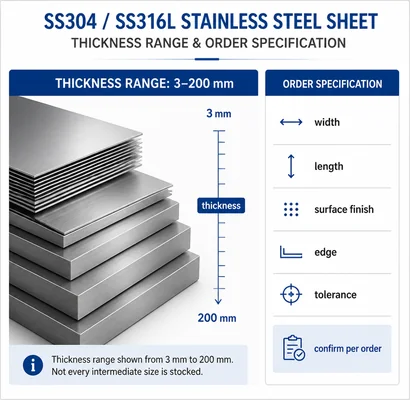
3-200mm Thickness SS304 SS316L Stainless Steel Sheet is not one fixed specification. It is a buyer’s range covering stainless sheet and plate requirements in two commonly requested austenitic grades. A reliable enquiry should state the selected grade, exact thickness, width, length, surface finish, edge, cutting route, applicable standard, inspection scope and packing requirement. SS304 and SS316L should not be treated as interchangeable by default, and a thickness range should not replace the exact dimension needed for production. The buyer should also separate confirmed facts from values that remain confirm per order. A clear line item prevents the grade, thickness and finish from being lost inside a general stainless steel request.
For a thin sheet, surface appearance, flatness, protection and downstream forming may drive the order. For a heavier plate, cutting, lifting, welding preparation, tolerance and transport planning become more important. The right purchase description connects the grade to the service environment and connects the thickness to the fabrication drawing. Values that depend on the mill route, project standard or inspection agreement remain confirm per order.
Why the 3-200mm Range Needs a Clear Sheet or Plate Definition
A buyer who writes “3-200 mm stainless steel sheet” has identified the broad thickness window but has not yet defined the supply condition. A 3 mm item may be handled as sheet in a fabrication shop, while a much heavier gauge may be supplied and handled as plate. The vocabulary affects cutting, lifting, packaging and the documents expected at delivery. It can also change which surface and flatness details deserve attention.
Start the request with the exact target thickness or a short approved list. Do not ask a supplier to quote every size from 3 to 200 mm unless the project genuinely needs a range. A clean list might separate thin, medium and heavy sections, then add width, length and quantity for each line. This prevents a broad range from hiding a missing tolerance or an unsuitable handling plan.
The order should also state whether the material is hot rolled or cold rolled where that distinction matters. Surface condition, edge condition and protection should be written beside the dimension rather than left to assumption. If the sheet will be cut, bent or welded, include the drawing and the downstream process so the supply route can be reviewed before production.
SS304 vs SS316L: Which Grade Fits the Project?
SS304 is often considered for general stainless fabrication, equipment panels, architectural work and components where the project specification calls for the 304 grade. SS316L is a low-carbon 316 grade selected when the project specifically requires that designation or when the service brief calls for its composition and corrosion-service considerations. The decision must follow the actual environment, process media, temperature, fabrication plan and governing specification.
Do not choose 316L only because the thickness is high, and do not choose 304 only because it is familiar. Ask what the sheet will contact, whether the surface will be washed or exposed outdoors, whether welding is required, and whether the customer specification names a grade. If a drawing or procurement standard names SS304, SS304L, SS316 or SS316L, keep that designation visible in the enquiry and ask for approval before any substitution.
Grade selection also affects documentation. The buyer may need heat or lot identification, chemical and mechanical information, dimensional records or a material certificate, but the exact package depends on the order. A supplier should confirm which documents are available rather than promising a certificate package that has not been agreed. For a related grade reference, compare 316 Stainless Steel.
How to Build a 3-200mm Stainless Steel Sheet Specification
A usable specification turns the long keyword into a short, checkable order. Put the grade and exact thickness on every line. Add width and length, or attach the cutting list when several sizes are required. State the surface finish, edge, flatness or tolerance requirement where relevant. Then record the standard, inspection scope, marking, surface protection and packing instruction.
| Order field | What the buyer should confirm |
|---|---|
| درجة | SS304 or SS316L; keep the approved designation unchanged |
| السُمك | Exact value within the 3-200 mm requested range and its tolerance |
| أبعاد | Width, length, cut list and any drawing reference |
| Supply condition | Sheet or plate, hot rolled or cold rolled where applicable |
| السطح | 2B, BA, No. 1, brushed or another specified finish |
| Edge and cutting | Mill edge, cut edge, bevel, holes or other preparation |
| Documents | Applicable standard, inspection scope and material records |
| التعبئة | Surface protection, bundle marking, lifting and export requirements |
This structure also makes quotation comparison easier. Two offers can be compared against the same grade, size, finish, tolerance, document and packing requirements instead of being compared only by a headline price. The related فولاذ مقاوم للصدأ 2B طلاء 2B page can help separate surface intent from grade intent.
Surface Finish, Cutting and Fabrication Checks
Surface finish is a functional and visual decision. A 2B finish may suit many fabricated and industrial components, while a brushed or other decorative finish may be selected for a visible architectural surface. The reference finish should be written with the grade and dimension, because “stainless steel sheet” alone does not describe the appearance expected at delivery.
Cutting requirements need equal care. A workshop may require fixed rectangles, nesting-based cut lengths, holes, bevels or an edge prepared for welding. Thick plate may need a different cutting sequence and lifting method from a thin sheet. Provide the drawing, tolerance and edge instruction before production. If the material will be formed, confirm the minimum bend or forming requirement with the selected grade, thickness and tooling plan.
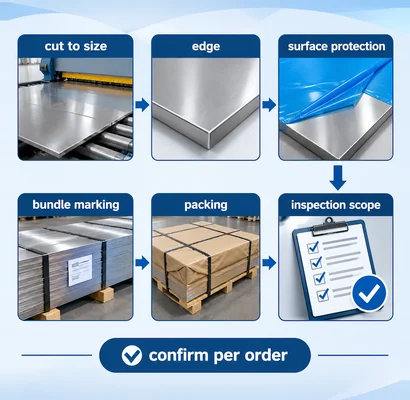
Protection should continue through processing. Film, paper, interleaf material or other protection may be discussed for a visible surface, but the actual method should be confirmed per order. The buyer should inspect the surface, dimensions, grade marking and bundle condition before fabrication starts.
Applications and Buying Decisions
The range can serve equipment panels, fabricated frames, architectural metalwork, storage or process components, maintenance parts and distributor stock when the selected grade and thickness match the project. The application does not remove the need for a defined standard. It tells the buyer which details deserve priority.
For a visible architectural project, finish, flatness, surface protection and consistent dimensions may lead the checklist. For a workshop fabrication order, cut list, edge, welding route and handling may matter more. For a process or storage component, grade, thickness, drawing, service environment and document requirements should be reviewed together. These are selection questions, not automatic claims about performance.
When the material will be exported, packaging and marking should be agreed before the order is released. Bundle weight, lifting points, moisture protection, container loading and traceability are practical details that can affect the receiving operation. Ask for a written confirmation covering the complete line item rather than relying on a general product name.
Inspection, Packaging and Delivery Confirmation
Inspection should match the risk in the order. Confirm grade designation, thickness, width, length, surface, edge, flatness or tolerance, marking and document scope. If the buyer needs a test report, material certificate or third-party inspection, name it before production. The exact availability and format remain confirm per order.
Packaging should protect the surface and keep the bundle identifiable. Confirm whether the sheets or plates need wrapping, interleaving, edge protection, moisture protection, pallets or special lifting marks. Heavy gauges require a loading plan that respects bundle weight and the buyer’s unloading equipment. Export marks should match the packing list and the traceability information required by the project.
Do not treat a delivery promise, warranty statement or supplier label on a reference marketplace page as a Bomis product fact. Delivery timing, warranty scope and document availability depend on the confirmed order and destination. Request a written commercial and technical confirmation before the purchase order is finalized.
FAQ – Stainless Steel Sheet Buying Questions
Does 3-200 mm mean every thickness is available?
No. It describes the requested range. Confirm the exact thickness, tolerance, supply condition and production route for each order line.
Is SS304 interchangeable with SS316L?
No automatic substitution should be made. Keep the grade named by the project, or obtain approval before changing the designation.
Should I call the material sheet or plate?
Use the term that matches the project and supply route. For heavier gauges, plate may describe handling and fabrication more clearly.
Can Bomis supply cut-to-size stainless steel?
Discuss the cutting list or drawing. Confirm dimensions, tolerance, edge condition, holes, bevels, surface protection and packing before production.
Which surface finish should I specify?
Specify the finish that matches the visible surface and downstream process, such as 2B, BA, No. 1 or brushed.
What should I request for a heavy stainless plate?
State the grade, thickness, width, length, tolerance, lifting and packing requirements. Add the drawing and inspection scope when needed.
Can I use the same specification for SS304 and SS316L?
Use the same order-field structure, but keep the grade as a separate approved value. Confirm grade, thickness, finish, standard and documents together.
Conclusion: Make the Stainless Steel Sheet Enquiry Checkable
A strong enquiry does more than repeat “3-200mm Thickness SS304 SS316L Stainless Steel Sheet.” It identifies the exact grade, thickness, dimensions, finish, edge, supply condition, standard, inspection scope and packing plan. Send the drawing or cutting list when available, separate different thicknesses into clear lines, and keep every unconfirmed value open for order confirmation. That gives the buyer a cleaner quotation comparison and gives the workshop a specification it can actually check.